

Reclining Buddha Statues
The reclining Buddha is among the most spiritually charged postures in all of Buddhist art; not sleep, but the moment of Mahaparinirvana itself: the historical Buddha Shakyamuni lying on his right side at Kushinagar, aged eighty, releasing his final attachment to earthly existence and passing into eternal liberation. Every statue in this collection was personally chosen during sourcing trips through Burma (Myanmar), Thailand, and Laos — regions where the reclining form has been rendered in gilded wood, bronze, marble, and carved stone for more than five centuries. Each piece is a singular, authenticated antique. None is reproduced. If you are searching for a reclining Buddha statue that carries actual history within it, you have arrived at the right place.
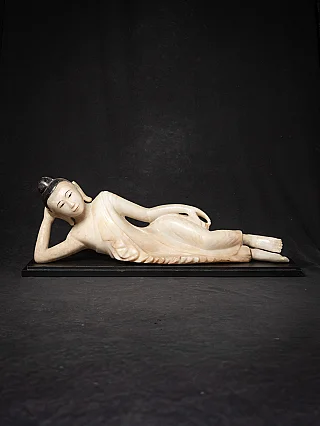
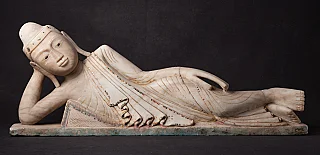
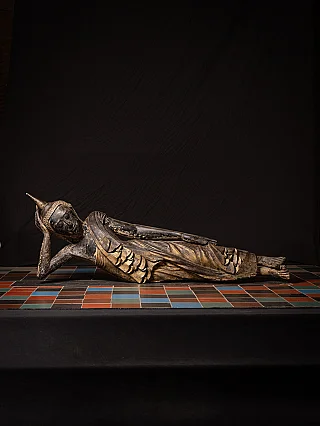
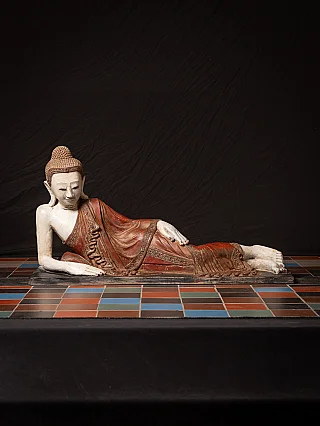
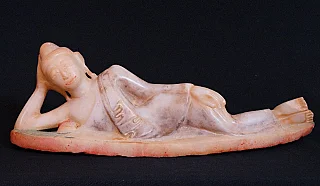
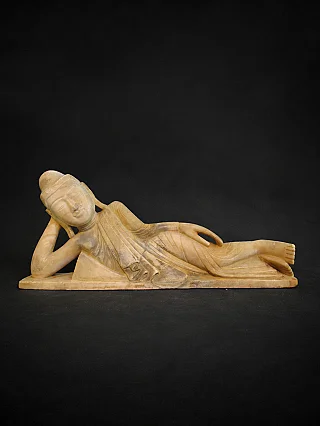
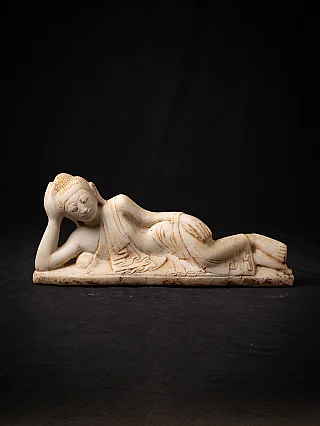
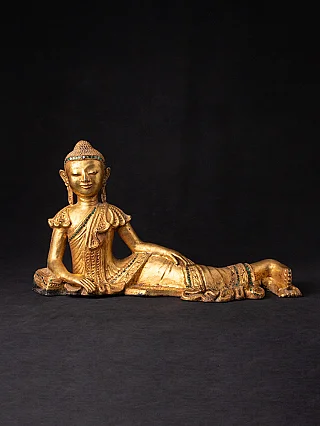
What the Reclining Buddha Posture Actually Means
The reclining Buddha — known in Sanskrit as the Parinirvana pose, and in Pali as parinibbāna — represents the most significant moment in the life story of the historical Buddha, Shakyamuni. He is depicted lying on his right side, his head resting on his right hand or a cushion, left hand along his body. His expression is not one of fatigue or sleep. It is complete serenity.
This posture documents the night at Kushinagar, in present-day Uttar Pradesh, India, where the Buddha passed from this existence having already achieved enlightenment. The Buddhist tradition distinguishes carefully between nirvana — liberation from suffering attained during life — and Mahaparinirvana (literally: great complete extinguishing), the final liberation at physical death. Only those who attain nirvana in life are said to reach Mahaparinirvana at death, becoming released from samsara permanently.
The reclining posture is therefore not mourning. It is triumph. The serene expression across all authentic reclining Buddha statues — whether Burmese gilded wood, Thai bronze, or Lao stone — reflects this: the complete freedom of one who no longer fears death, because for the Buddha, death was simply the door.
The Regional Traditions: Burma, Thailand, and Laos
Every reclining Buddha statue in this collection originates from one of three distinct Southeast Asian traditions. Understanding the differences sharpens your eye as a collector.
Burmese Reclining Buddha Statues
Burmese reclining Buddhas — particularly those from the Mandalay period (19th century) — are arguably the most refined in Southeast Asia. They are typically crafted from teak or other hardwoods, then:
- Covered in fine lacquer (thayo) as a base layer
- Decorated with mosaic glass inlay (shwei chi)
- Gilded with 22–24 karat gold leaf in multiple applications
The face is often elongated and stylized, with heavy-lidded eyes, a sharp Ushnisha (cranial protuberance denoting wisdom), and long stretched earlobes from a princely youth. Famous prototypes include the Shwethalyaung Buddha of Bago and the Chaukhtatgyi Buddha of Yangon — both among the world's largest reclining Buddhas.
Antique Burmese reclining Buddhas available through Original Buddhas range from intimate household-scale pieces to significant collector-grade figures. All are authenticated and sourced legally.
Thai Reclining Buddha Statues
Thai reclining Buddhas, best known through the Wat Pho Reclining Buddha in Bangkok (46 meters long, completed 1832), follow the iconographic conventions of Theravāda Buddhism, which dominates Thai religious life. Thai pieces tend toward:
- Bronze casting with high detail in robe folds
- Elongated proportions with elegant, flowing robes
- Mother-of-pearl inlay on the soles of the feet (depicting the 108 auspicious signs of the Buddha)
Antique Thai reclining Buddhas are rarer on the market than Burmese examples, making them particularly desirable for serious collectors.
Lao Reclining Buddha Statues
Lao reclining Buddha statues carry a distinctly regional character — often with broader, more rounded facial features, softer smiles, and a warmer, more approachable energy than their Burmese or Thai counterparts. The Wat That Luang temple complex in Vientiane is one of the most significant sites featuring Lao reclining Buddhas. Lao pieces are among the least represented in Western collections, making authenticated examples exceptionally rare.
Materials & Craftsmanship: What to Look For
Antique reclining Buddha statues are made from a defined set of materials across Southeast Asia. Each carries specific identification markers:
| Material | Primary Origin | Markers of Authenticity |
|---|---|---|
| Gilded teak / hardwood | Burma | Lacquer crazing, gold leaf flaking consistent with age, tool marks under gilding |
| Bronze | Thailand, Burma | Green-grey patina, casting seams, weight consistent with solid or hollow construction of the period |
| Marble / alabaster | Burma (Mandalay) | Warm honey or white tone, chisel marks, mineral staining on base |
| Soapstone | Burma (Mandalay) | Softer surface, grey-green tone, smooth weathering |
| Sandstone | Laos, Thailand | Granular texture, erosion consistent with temple exposure |
All statues in the Original Buddhas collection are personally assessed. Provenance documentation is provided with significant pieces.
Collector's Guide: Identifying a Genuinely Antique Reclining Buddha
Seasoned collectors assess reclining Buddha statues across five dimensions:
- Patina and aging — Authentic antiques show age consistently across all surfaces, including areas that would not be accessible for artificial weathering (joints, undersides, recessed carving). Bronze should show genuine verdigris, not applied patina. Gilded wood should show wear patterns at high-contact areas only.
- Iconographic accuracy — A genuine period piece follows the iconographic conventions of its region and era. The robe treatment, Ushnisha form, ear shape, and hand position all code to specific traditions. Anachronisms — such as a Mandalay-style face on a piece with Thai robe folds — indicate a reproduction.
- Tool marks — Hand-carved antiques show the imprecision of manual work. Machine-produced reproductions have a regularity and smoothness that antiques do not.
- Weight and density — Antique bronze pieces, especially those cast using lost-wax (cire-perdue) techniques, have a specific weight and resonance that differs from modern cast pieces.
- Provenance and sourcing — The most reliable indicator is the source. Original Buddhas personally travels to Burma, Thailand, and Laos to acquire pieces from private individuals, monasteries, and dealers with established relationships. No pieces from unknown provenance or auction houses without documentation are accepted.
Why a Reclining Buddha Statue — and Why Antique?
The reclining Buddha is not the most common Buddhist iconographic form (that distinction belongs to the seated meditating Buddha), which makes it all the more powerful when encountered. In a domestic or collector space, a reclining Buddha does something no seated figure does: it commands a horizontal axis. It stretches across a surface, dominating without aggression. The serenity is total.
As antique Buddhist art continues its transition from temple and monastery into private collections worldwide, authentic reclining Buddha statues have become increasingly scarce. The reasons are structural: temples do not sell. Private collections take decades to disperse. Antique dealers who travel to source rather than buying from intermediaries represent the narrowest, most reliable pipeline to genuine pieces.
Investment context: Authenticated antique Southeast Asian Buddhist sculpture has shown consistent appreciation in value over the past two decades, driven by growing collector demand in the United States, Germany, Netherlands, United Kingdom, and Australia — markets where Original Buddhas has established collector relationships.
Placement & Care for Your Reclining Buddha Statue
Placement traditions:
- Orient the statue so the Buddha's head faces east or north — the direction associated with the Kushinagar event in Buddhist tradition
- Place on an elevated surface (altar table, shelf, console) — never directly on the floor
- Ensure the statue's face is visible from the room entrance, allowing the serene expression to be encountered naturally
- In meditation spaces, the reclining Buddha is traditionally positioned opposite the meditator, creating a visual anchor for practice
Care by material:
- Gilded wood: Dust with a dry soft brush. Avoid moisture and direct sunlight. Do not apply oils or polishes. Allow natural humidity variation to be slow — rapid changes cause cracking.
- Bronze: Wipe with a dry cloth. If genuine patina is present, do not clean aggressively. A light wax coating (microcrystalline) protects without altering appearance.
- Stone (marble, alabaster, sandstone): Dust regularly. Avoid acidic cleaners. Stone reclining Buddhas tolerate outdoor settings in temperate climates but benefit from shelter in harsh winters.
Related Categories in the Original Buddhas Collection
If you are exploring reclining Buddha statues, you may also have interest in:
- Burmese Buddha Statues — The full range of Burmese Buddhist sculpture, including seated, standing, and crowned forms
- Thai Buddha Statues — Thai bronze and gilded sculpture spanning multiple periods
- Lao Buddha Statues — Rare and underrepresented Lao Buddhist art
- About Buddha Statues — A deep reference guide to Buddhist iconography, postures, mudras, and materials
- Authenticity — How Original Buddhas assesses and guarantees the authenticity of every piece
Frequently Asked Questions About Reclining Buddha Statues
What does the reclining Buddha symbolize?
The reclining Buddha depicts the moment of Mahaparinirvana — the Buddha's peaceful transition from life into final liberation. He is shown lying on his right side at Kushinagar, in present-day India, at the age of eighty. The posture represents total freedom from samsara (the cycle of rebirth), and is considered the most spiritually complete of all Buddha poses.
Is a reclining Buddha the same as a sleeping Buddha?
No, though the terms are often used interchangeably in casual contexts. A sleeping Buddha simply rests. The reclining Buddha specifically represents Parinirvana — the Buddha's final passing — and is a deeply intentional iconographic statement, not a depiction of sleep.
What is a Parinirvana Buddha?
"Parinirvana Buddha" is the formal name for the reclining Buddha posture. Parinirvana (Sanskrit: parinirvāṇa; Pali: parinibbāna) means "complete nirvana" or "final nirvana" — the liberation from the cycle of rebirth that occurs at the physical death of an enlightened being. All authentic reclining Buddha statues from Southeast Asian traditions represent this specific event.
Which direction should a reclining Buddha face in my home?
In Buddhist tradition, the Buddha at Kushinagar is said to have lain with his head facing north. Most practitioners and placement guides recommend orienting a reclining Buddha with the head toward the north or east. The face should be visible from the main approach point in the room.
What makes Burmese reclining Buddha statues different from Thai ones?
Burmese reclining Buddhas (especially Mandalay-period antiques) typically feature gilded lacquered wood with mosaic glass inlay, elongated stylized facial features, and a more formal aesthetic. Thai reclining Buddhas are more commonly cast in bronze, with flowing robe detail and, in important examples, mother-of-pearl inlay on the feet. Lao examples are softer and rounder in facial expression. Material, proportion, and surface treatment together signal the regional tradition.
Are there large reclining Buddha statues available?
The Original Buddhas collection includes reclining Buddha statues ranging from small portable pieces (under 20 cm) to significant gallery-scale figures. Available sizes and dimensions are listed on each individual product page. For significant or large pieces, contact Original Buddhas directly for shipping consultation.
Do reclining Buddha statues have value as investments?
Authenticated antique reclining Buddha statues from Southeast Asia have appreciated consistently as collector demand has grown in Western markets. Scarcity is increasing: as fewer temples and private collections deaccession antique pieces, and as export restrictions tighten across source countries, supply continues to contract. Original Buddhas provides authentication documentation, which is essential for any collector considering long-term value.