

Laos Buddha Statues
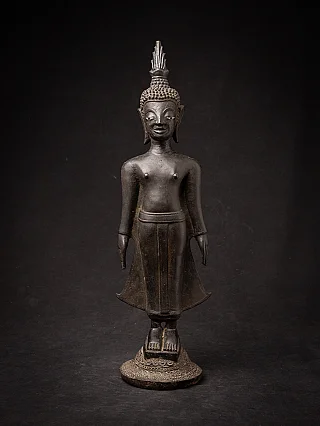
Buddhism became the state religion of Laos in 1353, when King Fa Ngum founded the Lan Xang kingdom, the "Land of a Million Elephants," with support from the Khmer court of Cambodia. Our Laos collection reflects the slender, elongated forms that followed, including standing Buddha statues carved in the distinctive posture Laos is best known for.
Many pieces are worked in wood or cast in bronze by artisans of the Tai Lue tradition, later lacquered and gilded for temple use. Together with our antique Buddha heads, these statues trace how a small Mekong kingdom developed one of Southeast Asia's most distinctive Buddhist art styles.
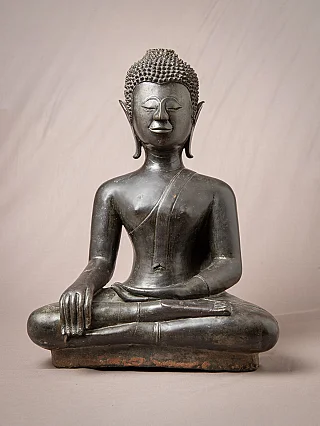


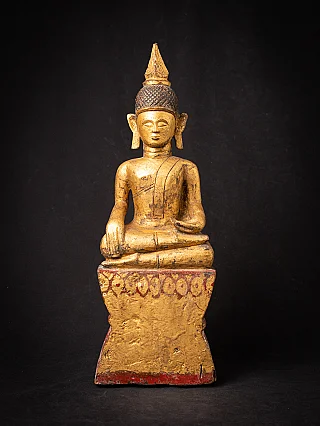
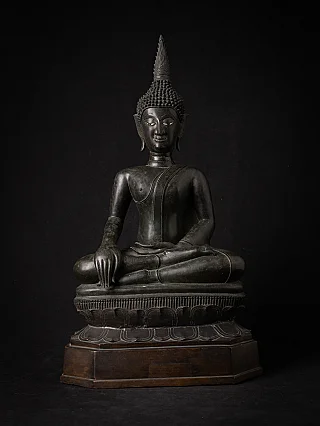
Laos: Buddhist Art of the Lan Xang Kingdom
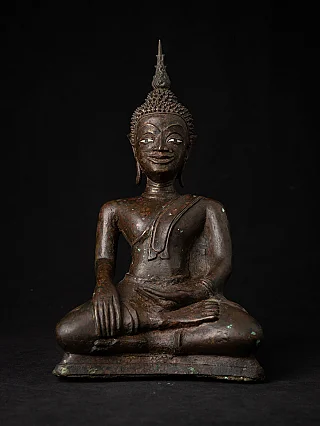
Buddhism arrived in Laos centuries earlier through Mon and Khmer contact, but it became firmly established as the state religion in 1353, when King Fa Ngum founded Lan Xang, the "Land of a Million Elephants." Fa Ngum had grown up at the Khmer court of Angkor and married a Khmer princess, and it was largely through this connection to Cambodia that Theravada Buddhism and its accompanying artistic conventions took hold along the Mekong. Lao sculptors reinterpreted earlier Indian and Khmer Buddha statues into slender, elongated figures with distinctive hooked noses and gently smiling faces.
The Chiang Saen and Lanna Connection
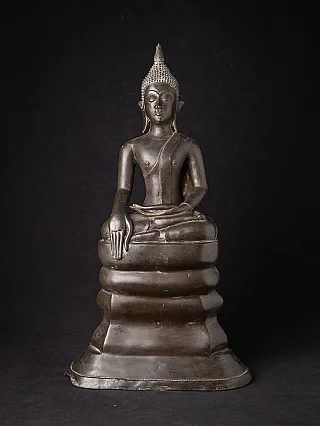
Because Lan Xang bordered the Lanna kingdom across the Mekong, early Lao Buddha statues share close stylistic ties with the Chiang Saen style of northern Thailand, both favoring rounded faces, tightly curled hair, and a seated posture with legs folded in the "diamond" position. Over time, Lao artisans developed their own variations, producing figures that are more linear and abstracted than their Thai counterparts.
Materials and the Tai Lue Woodcarving Tradition
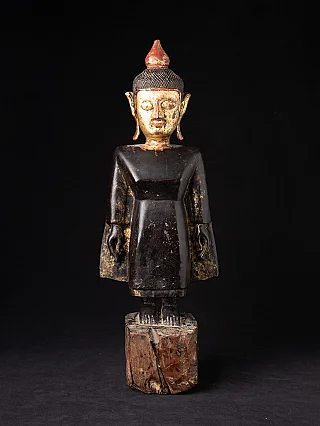
Wood, particularly teak, has always been central to Lao Buddhist art, carved by artisans of the Tai Lue ethnic tradition and often finished with red or black lacquer and gold leaf. Bronze casting was reserved for temple centerpieces and important commissions, while smaller wooden figures and Buddha heads were made as personal devotional objects or offerings placed in temple shrines and altars.
Calling for Rain: Laos' Signature Standing Posture
No gesture is more closely associated with Lao Buddhist art than the "Calling for Rain" posture, a standing Buddha statue with arms held straight down against the sides of the body, palms facing inward. Rarely found outside Laos and northern Thailand, this posture depicts the Buddha invoking rainfall to end a drought, a fitting image for a kingdom whose fortunes depended on the Mekong's seasonal floods.
Mudras in Lao Buddhist Sculpture
Beyond this regional posture, Lao statues also rely on the classical hand gestures shared across the Buddhist world. The Bhumisparsha mudra marks the Buddha's enlightenment, while the Abhaya mudra, closely related to the calling-for-rain gesture, conveys protection and fearlessness, each rendered with the narrow shoulders and pointed ushnisha typical of Lao workmanship.
Lao Art Compared with Its Neighbors
Sandwiched between Thailand, Cambodia, and Myanmar, Laos absorbed influences from all three while keeping its sculpture recognizably its own, more slender than Thai Sukhothai work, less ornamented than Khmer stone carving, and more linear than Burmese bronzes. French colonial rule in the 19th and 20th centuries later disrupted much of this tradition, making surviving antique Lao statues, especially pre-colonial bronzes, increasingly rare today.
Frequently Asked Questions
Are these Laos Buddha statues genuinely antique?
Yes. Every piece in our Laos collection is an original antique, personally inspected and authenticated for age, material, and craftsmanship before it is listed. We do not sell modern reproductions.
What materials are Laos Buddha statues made from?
Lao statues are typically carved from teak or other hardwoods, or cast in bronze, and often finished with lacquer and gold leaf for temple use.
What does the "Calling for Rain" posture mean?
It shows the Buddha standing with arms straight at his sides, palms turned inward, invoking rainfall. It is one of the most distinctive postures in Lao and northern Thai Buddhist art.
How do Laos Buddha statues differ from Thai or Khmer statues?
Lao statues tend to be more slender and linear, with narrower shoulders and pointed ushnisha, compared to the rounder Sukhothai forms of Thailand or the heavier stone carving traditions of Cambodia.
Why are antique Laos Buddha statues rare?
Decades of conflict and French colonial rule disrupted temple production and preservation in Laos, making surviving pre-20th-century statues considerably harder to find than those from neighboring countries.
Do you ship Laos Buddha statues internationally?
Yes, we ship worldwide. Each antique is carefully packed, and we handle the export documentation required for shipping cultural items abroad.