

Cambodia Buddha Statues
Buddhism spread through the Khmer Empire alongside Hinduism for centuries before becoming the region's dominant faith in the 13th century, a shift visible in the enormous stone faces of Angkor's Bayon temple. Our Cambodia collection reflects this legacy, from sitting Buddha statues sheltered beneath the hood of the serpent king Muchalinda to weathered Buddha heads rescued from temple ruins.
Most pieces are carved from sandstone or cast in bronze, materials that allowed Khmer artisans to work at the monumental scale seen throughout Angkor. Together with our wider collection of Buddha statues, these pieces trace how Cambodia's art absorbed both Indian and Hindu influence into something unmistakably Khmer.
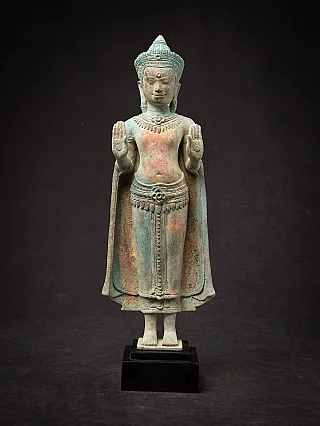
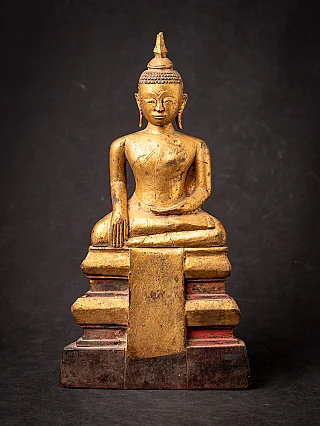
Cambodia: Buddhist Art in the Shadow of Angkor
Buddhism arrived in Cambodia alongside Hinduism during the early centuries of the Khmer Empire, and for hundreds of years the two faiths coexisted, sharing temples, iconography, and royal patronage. It was not until the reign of Jayavarman VII in the late 12th century, and more fully in the 13th and 14th centuries, that Theravada Buddhism became the kingdom's dominant religion, gradually replacing the Hindu god-king cult that had produced Hindu-inspired monuments like Angkor Wat. Khmer sculptors reworked earlier Indian Buddha statues into a style marked by broad, serene faces and a distinctive stillness.
From Angkor Wat to Bayon: Stone Faces of Compassion
No monument illustrates this religious shift better than the Bayon temple at Angkor Thom, built under Jayavarman VII and decorated with over 200 enormous stone faces, widely believed to represent the bodhisattva of compassion, and possibly the king himself. These faces mark one of the high points of Khmer stone carving, an artistic scale rarely attempted elsewhere in the Buddhist world, and their weathered fragments and Buddha heads remain among the most recognizable relics of the empire.
Materials: Sandstone, Laterite, and Bronze
Unlike the wood-carving traditions of mainland Southeast Asia, Khmer artisans favored sandstone and laterite for large temple sculpture, materials that allowed the monumental scale seen throughout Angkor. Smaller devotional images, often kept in household shrines and altars, were more commonly cast in bronze, a practice that continued well after Angkor's political decline in the 15th century.
Naga-Sheltered Buddhas: A Khmer Signature
Perhaps the most distinctive Khmer contribution to Buddhist iconography is the image of the seated Buddha protected by Muchalinda, the serpent king, whose coiled body forms a throne and whose multi-headed hood shelters the Buddha from a storm. This motif, rooted in a specific episode from the Buddha's life, became far more prominent in Cambodia than anywhere else in Asia and later spread into neighboring Thai art.
Mudras in Khmer Buddhist Sculpture
Khmer Buddha statues frequently combine the naga motif with classical hand gestures such as the Bhumisparsha mudra, marking the moment of enlightenment, while the Dhyana mudra appears on meditating figures, both rendered with the flatter, more angular hands typical of Khmer craftsmanship.
Khmer Art Compared with Its Neighbors
Khmer artistic influence spread west into the Lopburi region of Thailand and north along the Mekong into Laos, leaving a visible imprint on both traditions even after Angkor's fall. Centuries of war and, more recently, the Khmer Rouge period caused severe losses and looting of Cambodian religious art, making surviving antique statues, especially pre-20th-century bronzes, considerably rarer today than their Thai or Burmese counterparts.
Frequently Asked Questions
Are these Cambodia Buddha statues genuinely antique?
Yes. Every piece in our Cambodia collection is an original antique, personally inspected and authenticated for age, material, and craftsmanship before it is listed. We do not sell modern reproductions.
What materials are Cambodia Buddha statues made from?
Large temple sculpture was typically carved from sandstone or laterite, while smaller devotional statues were cast in bronze, a tradition that continued for centuries after Angkor's decline.
What does the naga-sheltered Buddha represent?
It depicts the serpent king Muchalinda shielding the meditating Buddha from a storm with his hood, a motif especially prominent in Khmer art and later adopted in neighboring Thailand.
Why are antique Cambodian Buddha statues rare?
Centuries of conflict, temple looting, and the destruction of the Khmer Rouge era severely reduced the number of surviving antique statues, making authenticated pieces considerably harder to find today.
How does Khmer Buddhist art differ from Thai or Lao art?
Khmer sculpture favors broad, serene stone faces and monumental scale tied to temple architecture, while Thai and Lao traditions lean more toward smaller bronze figures with elongated, linear forms.
Do you ship Cambodia Buddha statues internationally?
Yes, we ship worldwide. Each antique is carefully packed, and we handle the export documentation required for shipping cultural items abroad.