

Rattanakosin Period
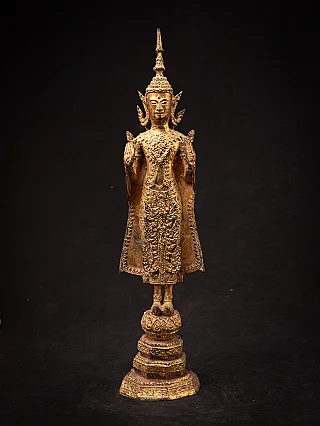
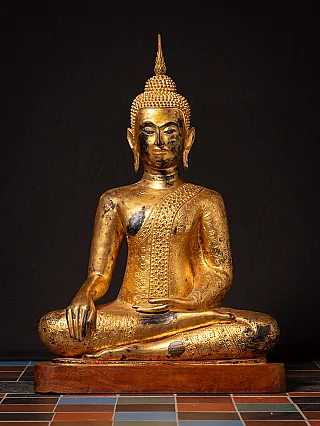
The Rattanakosin period began in 1782 with the founding of Bangkok as Thailand's capital, and continues to the present day under the Chakri dynasty. Rattanakosin Buddha statues refine the Ayutthaya tradition into a more elegant, gilded style, with elongated proportions and a flame-like finial. Our collection features antique bronze statues from Thailand.
Characteristics of Rattanakosin Buddha Statues
Rattanakosin Buddha statues are typically cast in bronze, often finished with gold leaf or lacquer, and carved from wood for temple and household shrines. Below are the materials most commonly found in this period's statuary:
- Bronze statues: cast using traditional lost-wax methods and finished with gilding or black lacquer, the most common material of the period.
- Wooden statues: carved and often gilded, used for both temple images and home altars.
- Stone statues: less common than bronze, but used for garden and temple settings.
What Is the Rattanakosin Period?
The Rattanakosin period began in 1782, when King Rama I founded Bangkok as the new capital of Siam and established the Chakri dynasty, which still reigns in Thailand today. Rattanakosin Buddhist art refined the traditions of the preceding Ayutthaya period, producing statues with a more elegant, elongated silhouette, a slender flame-shaped finial (ushnisha), and finely detailed gilded or lacquered surfaces. The period spans from the late 18th century to the present day, making it the longest-running and most continuous tradition in Thai Buddhist sculpture.
How to Identify a Rattanakosin Buddha Statue
Rattanakosin statues are known for their refined, almost delicate elegance: a slim, elongated face and body, arched eyebrows, a serene half-smile, and a tall, narrow flame finial rising from the head. The robes are usually rendered with crisp, smooth lines rather than the more elaborate jeweled ornamentation seen in later Ayutthaya statues. Gilding and black-and-gold lacquer work (lai rot nam) are common finishing techniques, and bases are often lotus-shaped or multi-tiered.
Placing and Collecting a Rattanakosin Buddha Statue
As the most recent and refined chapter of Thai Buddhist sculpture, Rattanakosin statues suit both traditional and contemporary settings:
- Home altar or shrine: a fitting centerpiece for daily devotion, in keeping with Thai temple tradition.
- Living or dining room: the refined gilded finish works well as an elegant focal point.
- Meditation space: the serene expression supports quiet reflection.
- Collections of Thai art: a natural complement to earlier Ayutthaya pieces, illustrating the evolution of the tradition.
Explore Other Buddhist Art Periods
Rattanakosin is one of several historical periods represented in our collection, each with its own regional style and history:
- Ayutthaya period statues: four centuries of Thai kingdom art blending Sukhothai and Khmer influences.
- Pyu period statues: among the earliest Buddhist art in Burma, shaped by early Indian influence.
- Bagan period statues: the classical style of Burma's first unified kingdom.
Frequently Asked Questions
When was the Rattanakosin period?
It began in 1782 with the founding of Bangkok as Thailand's capital and continues to the present day under the Chakri dynasty.
What makes Rattanakosin Buddha statues distinctive?
A slender, elongated silhouette, a tall flame-shaped finial, a serene half-smile, and refined gilded or black-and-gold lacquer finishing.
What is the difference between Rattanakosin and Ayutthaya statues?
Rattanakosin statues refine the Ayutthaya tradition into a slimmer, more restrained silhouette with cleaner lines, while later Ayutthaya pieces often carry heavier, more elaborate jeweled and crowned ornamentation.
What materials were used for Rattanakosin Buddha statues?
Bronze is most common, often gilded or lacquered, alongside carved and gilded wood and, less frequently, stone.