

Japan statues
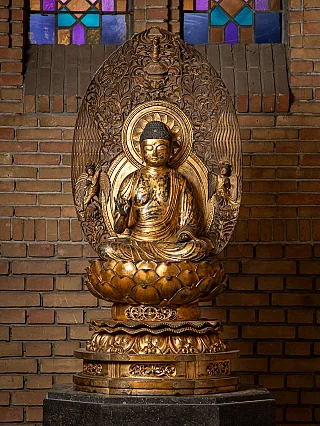
Buddhism arrived in Japan in the 6th century CE via Korea, and over the following centuries merged with native Shinto beliefs to form a distinctly Japanese visual language. Our Japan collection reflects this heritage, from meditative seated Buddha statues of Amida to depictions of Kannon, the bodhisattva of mercy beloved across Japanese Buddhism.
Pieces are typically carved from cypress wood, finished with lacquer and gold leaf, or cast in bronze, using techniques refined over a thousand years. Together with our antique Buddha heads, these statues show how Japan transformed an imported Chinese and Korean tradition into an entirely distinct art form.
Japan: Buddhism's Journey to the Far East
Buddhism is traditionally said to have arrived in Japan in 552 CE, sent as a gift from the Korean kingdom of Baekje, and it was formally embraced by the Japanese court under the regency of Prince Shotoku around the turn of the 7th century. Rather than replacing the indigenous Shinto religion, Buddhism gradually merged with it in a syncretism known as shinbutsu-shugo, a fusion that shaped Japanese Buddha statues for well over a thousand years, giving them a restraint and quietness distinct from their continental counterparts.
Zen and the Art of Simplicity
Zen Buddhism, an offshoot of China's Chan school, took root in Japan during the Kamakura period through monks such as Eisai and Dogen in the 12th and 13th centuries. Its emphasis on direct experience over ritual complexity influenced not only meditation practice but also the visual arts, encouraging a pared-back aesthetic, later known as wabi-sabi, that favored understated wood and simple forms over elaborate ornamentation.
Amida Buddha and Pure Land Buddhism
Few figures are as central to Japanese Buddhist art as Amida, the Buddha of Infinite Light, worshipped within Pure Land Buddhism as a savior who welcomes the faithful into his Western Paradise. Founded as a distinct school by the monk Honen in the 12th century, Pure Land Buddhism produced countless serene seated Amida statues, among the most commonly encountered figures in Japanese antique collections today.
Kannon: Japan's Beloved Bodhisattva of Mercy
Just as Guan Yin became China's most venerated bodhisattva, the same figure, known in Japan as Kannon, occupies an equally central place in Japanese devotion. Descended from the Indian Avalokiteshvara by way of China, Kannon is worshipped in dozens of forms across Japan, from the thousand-armed Senju Kannon to the horse-headed Bato Kannon, and remains one of the most frequently depicted figures in Japanese Buddhist sculpture.
Materials and Craftsmanship: Wood, Lacquer, and Bronze
Japanese sculptors favored cypress wood above all else, developing the yosegi-zukuri technique of joining multiple carved blocks, pioneered by the sculptor Jocho in the 11th century, to build large figures without the risk of a single trunk cracking. Statues were often finished with lacquer, gold leaf, or inlaid crystal eyes, while monumental bronze Buddhas, and countless individual Buddha heads, were also cast for temples and household shrines and altars alike.
Mudras in Japanese Buddhist Art
Japanese Buddha statues rely on the same symbolic hand gestures found throughout Buddhist Asia. The Dhyana mudra appears frequently on meditating Amida figures, while the Bhumisparsha mudra marks the moment of enlightenment, both rendered with the smooth, understated modeling typical of Japanese woodcarving.
Japanese Art Compared with Neighboring Traditions
Japan's Buddhist art absorbed successive waves of influence from China, by way of Chan Buddhism and Tang-dynasty aesthetics, while sharing little direct contact with the Vajrayana traditions of Tibet further west. Comparing Japanese restraint with Chinese ornamentation and Tibetan intensity shows how the same religion, carried along very different routes, could produce such distinct regional expressions.
Frequently Asked Questions
Are these Japanese Buddha statues genuinely antique?
Yes. Every piece in our Japan collection is an original antique, personally inspected and authenticated for age, material, and craftsmanship before it is listed. We do not sell modern reproductions.
What materials are Japanese Buddha statues made from?
Most are carved from cypress or other fine woods using the joined-block yosegi-zukuri technique, then finished with lacquer or gold leaf, while larger devotional images are cast in bronze.
Who is Amida Buddha?
Amida, the Buddha of Infinite Light, is the central figure of Pure Land Buddhism, believed to welcome devoted followers into his Western Paradise after death.
Who is Kannon, and how does she relate to Guan Yin?
Kannon is the Japanese form of the bodhisattva of compassion known as Guan Yin in China and Avalokiteshvara in India, worshipped across Japan in many forms, including the thousand-armed Senju Kannon.
How does Japanese Buddhist art differ from Chinese art?
Japanese statues, especially after the rise of Zen, tend toward understated wood carving and quiet restraint, while Chinese statues often favor rounder, more ornamented bronze and porcelain forms.
Do you ship Japanese Buddha statues internationally?
Yes, we ship worldwide. Each antique is carefully packed, and we handle the export documentation required for shipping cultural items abroad.