

Chinese statues
Buddhism reached China around the 1st century CE along the Silk Road from India and Central Asia, and over the centuries it blended with native Daoist and Confucian thought to become something distinctly Chinese. Our China collection reflects that fusion, from serene sitting Buddha statues to figures of Guan Yin, the beloved bodhisattva of compassion who took on a uniquely Chinese, often female form.
Pieces are carved in wood and stone or cast in bronze, each showing the elongated features and flowing drapery associated with Chinese Buddhist art. Together with our antique Buddha heads, these statues offer a window into how an Indian religion became one of China's defining spiritual traditions.

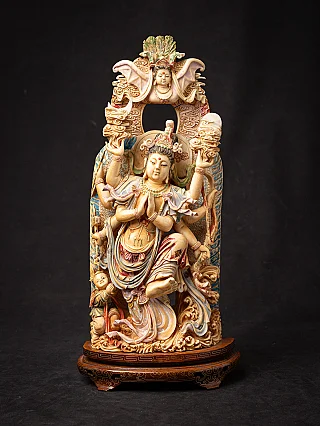
China: Where Buddhism Met a New Artistic Tradition
Buddhism arrived in China from India and Central Asia along the Silk Road around the 1st century CE, during the Han dynasty. Over the following centuries, and especially under the Tang dynasty, it spread widely and merged with existing Daoist and Confucian thought, gradually developing into something distinctly Chinese, including the meditative Chan school later known in the West by its Japanese name, Zen. Chinese sculptors reinterpreted Indian Buddha statues through a local lens, producing figures with elongated earlobes, serene, rounded faces, and the flowing, layered drapery characteristic of Chinese court and temple art.
Cave Temples and the Birth of a National Style
Much of what we know about early Chinese Buddhist sculpture comes from monumental cave temple complexes such as the Mogao Caves at Dunhuang, and the Yungang and Longmen Grottoes, where thousands of Buddha images, and countless individual Buddha heads, were carved directly into cliff faces over several dynasties. These UNESCO-listed sites trace the gradual shift from Indian and Central Asian sculptural conventions toward a fully developed Chinese style, one that would go on to influence Buddhist art across East Asia.
Materials and Craftsmanship: Bronze, Wood, Stone, and Porcelain
Chinese Buddhist statues were traditionally cast in bronze, carved from wood or stone, or, uniquely among Buddhist traditions, shaped from porcelain. The kilns of Dehua in Fujian province became famous for their ivory-white "blanc de Chine" porcelain figures, prized for centuries both within China and among European collectors. Jade carving, closely tied to Chinese ideas of purity and virtue, is another material rarely seen in Buddhist sculpture from other regions, alongside carved temple shrines and altars meant for home worship.
Guan Yin: China's Most Beloved Bodhisattva
No figure illustrates China's transformation of Buddhist art more clearly than Guan Yin. Originally the male Indian bodhisattva Avalokiteshvara, this figure of compassion was gradually reimagined in China as a graceful, often maternal female deity associated with mercy, healing, and protection. Guan Yin remains one of the most widely venerated figures in Chinese religious life, frequently depicted seated or standing in her own right, separately from, and even more popularly than, the seated Buddha himself.
Mudras and Symbolism in Chinese Buddhist Art
Despite these regional innovations, Chinese Buddha statues still rely on the same symbolic hand gestures found throughout Buddhist Asia. The Bhumisparsha mudra marks the moment of enlightenment, the Abhaya mudra conveys protection and reassurance, and the Dharmachakra mudra represents the Buddha's teaching, each gesture carried into China from its Indian origins and rendered in a distinctly local style.
Chinese Buddhist Art Compared with Neighboring Traditions
China's Chan Buddhism travelled onward to Japan, where it became Zen, while Vajrayana Buddhism arrived in China from Tibet during the Yuan and Qing dynasties, leaving temples in Beijing that still reflect Tibetan influence today. Comparing Chinese statues with these neighboring traditions, and with the Indian sculpture that started it all, shows how a single religion, carried along trade routes, could take on such different artistic lives across Asia.
Frequently Asked Questions
Are these Chinese Buddha statues genuinely antique?
Yes. Every piece in our China collection is an original antique, personally inspected and authenticated for age, material, and craftsmanship before it is listed. We do not sell modern reproductions.
What materials are Chinese Buddha statues made from?
Chinese statues are typically cast in bronze, carved from wood or stone, or shaped from porcelain and jade, materials rarely used for Buddhist sculpture elsewhere in Asia.
Who is Guan Yin, and why is she shown as a woman?
Guan Yin began as the male Indian bodhisattva Avalokiteshvara. Over centuries in China, the figure was reimagined as a compassionate, often maternal female deity, and is now one of the most widely worshipped figures in Chinese religious life.
How does Chinese Buddhist art differ from Japanese or Tibetan styles?
Chinese statues tend toward rounded, serene faces and flowing drapery influenced by Daoist and Confucian aesthetics, while Japanese Zen sculpture, descended from Chinese Chan Buddhism, is often more restrained, and Tibetan statues favor vivid color and elaborate ornamentation from Vajrayana tradition.
How should I care for an antique Chinese bronze, wood, or porcelain statue?
Keep wooden and porcelain statues away from direct sunlight and sudden temperature changes, dust bronze pieces with a soft, dry cloth, and avoid household cleaning products on any antique surface, since these can damage original patina or glaze.
Do you ship Chinese Buddha statues internationally?
Yes, we ship worldwide. Each antique is carefully packed, and we handle the export documentation required for shipping cultural items abroad.