A 12th-Century Manjushri Sets a World Auction Record in Hong Kong
Author : Peter Vredeveld · Published
On 30 October 2026, a gilt-copper figure of Manjushri, the bodhisattva of wisdom, sold at Christie's in Hong Kong for HK$137.35 million, about 17.5 million US dollars. That is more than double the low estimate and a new world auction record for a Himalayan gilt-bronze sculpture. It was also the most expensive lot of Christie's whole autumn season in Hong Kong, ahead of every imperial Chinese porcelain and painting in the sales.
For anyone who loves Himalayan art, this is wonderful news. It shows how highly the work of the Newar bronze casters of the Kathmandu Valley is valued today, nine centuries after this statue was made.
A masterpiece of Newar casting
The statue stands 93 cm high, which is very large for an early Himalayan bronze. Manjushri stands upright, crowned and richly jewelled, with necklaces, armlets, bracelets and a sacred thread. On a lotus at his shoulder rests the Prajnaparamita sutra, the book of perfect wisdom that is one of his signs.
Christie's calls the figure a masterpiece of the Newar sculptural tradition and compares it with early gilt-copper bodhisattvas in the British Museum, the Victoria and Albert Museum and the Norton Simon Museum in Pasadena. It was offered in a single-owner sale, Awakening Wisdom: Masterpieces of Buddhist Art from a Private Asian Collection, during Hong Kong Asian Art Week. Together with the regular sale of Indian, Himalayan and Southeast Asian art, the category brought in HK$283 million, which Christie's says is the highest total ever reached for it.
Who is Manjushri?
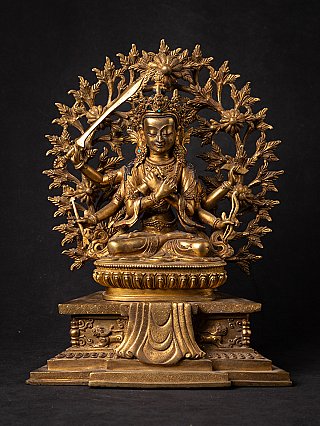
Manjushri is the bodhisattva of wisdom. He is usually shown as a young prince holding a flaming sword, which cuts through ignorance, and the book of wisdom, often resting on a lotus at his shoulder. In the Kathmandu Valley he has a special place: according to local legend, the valley was once a lake, and Manjushri cut through the hills with his sword so the water could drain away and people could settle there. Read more about Manjushri and the other great bodhisattvas.
Why Newar bronzes are so admired
The Newars of the Kathmandu Valley have been casting sacred images for more than a thousand years, and their skill was famous far beyond Nepal. Newar artists worked for monasteries in Tibet, and in the 13th century the Newar master Araniko travelled to the court of Kublai Khan in China.
Their statues are made with the lost-wax method: every figure is first modelled in wax, so each mould is used only once and every statue is unique. The best pieces are fire gilded, a technique in which gold is bonded to the copper with heat, and finished by hand with fine chasing and inlaid stones. Families in Patan still work this way today. Read about bronze casting in Patan and bronze Buddha statues.
What a record statue teaches every collector
Very few of us will ever own a 12th-century masterpiece, but the qualities that make this Manjushri special are the same ones to look for in any Nepalese bronze: a calm, finely modelled face, crisp detail in the crown and jewellery, warm and even fire gilding rather than paint, balanced proportions and a properly finished base. Our article on how to identify an antique statue explains what to look at, and the Buddha statues from Nepal page shows how to recognise Nepalese work.
Old statues and the law in Nepal
Nepal protects its cultural heritage carefully. Statues and other objects more than about a hundred years old may not leave the country without permission from the Department of Archaeology. We follow the laws of every country we buy in, and we guarantee that the age we give for each statue is correct. See our authenticity guarantee.
Manjushri statues in our collection
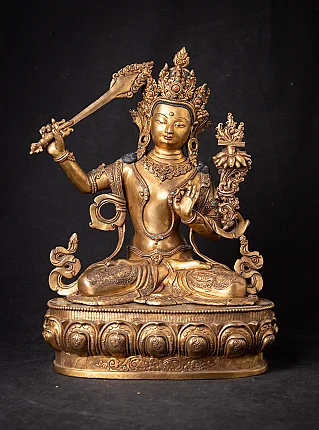
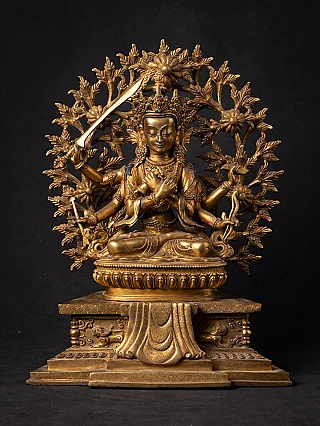
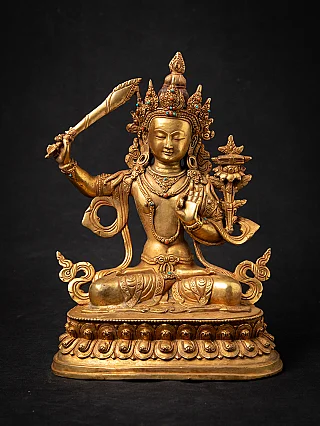
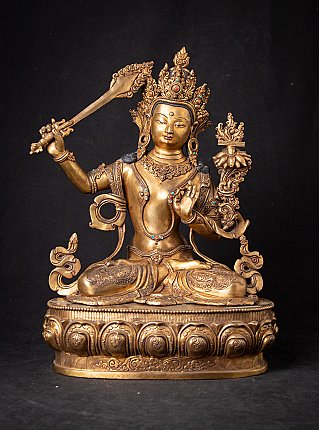
In our gallery in Deventer you will find several fire-gilded Manjushri statues from Nepal, cast by Newar craftsmen in the middle of the 20th century in the same tradition as the record statue. Some are set with semi-precious stones. You are welcome to visit and see them in person, or browse them below.
Discover our statues from Nepal
Share this page