Buddha Statues from Nepal: How to Recognise Them
By Peter Vredeveld, collector of Buddhist art
Nepal has a special place in our collection. We have family ties with the country, we travel there several times a year, and we always have a few hundred statues from Nepal in stock.
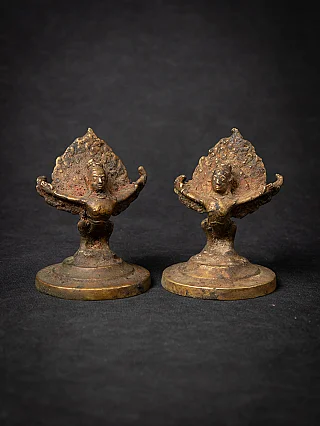
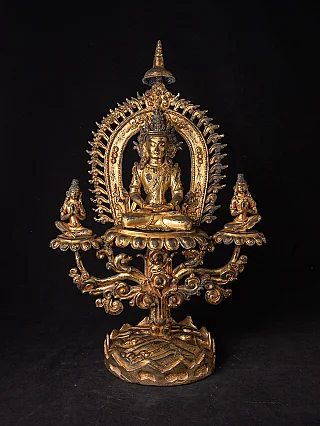
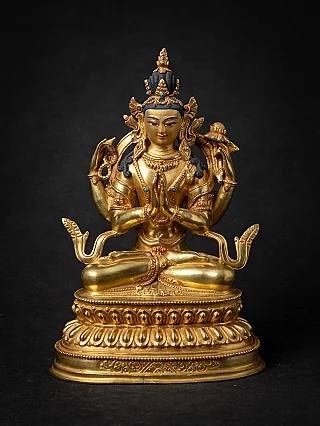
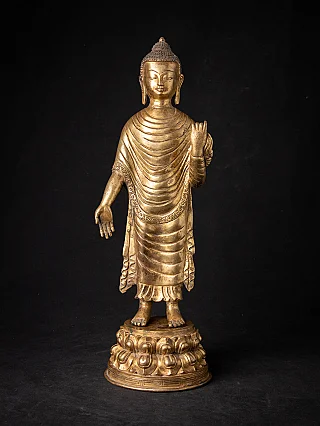
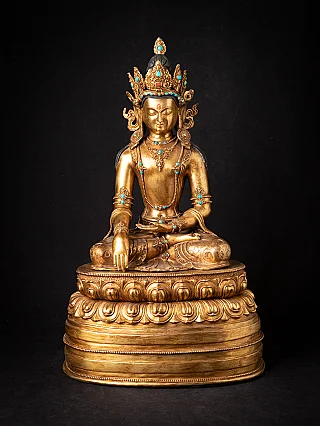
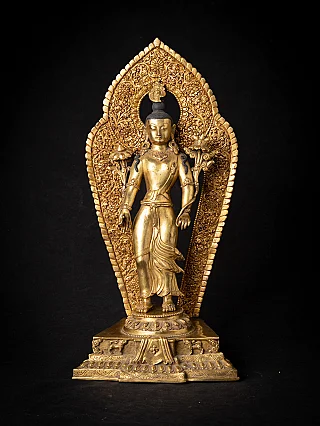
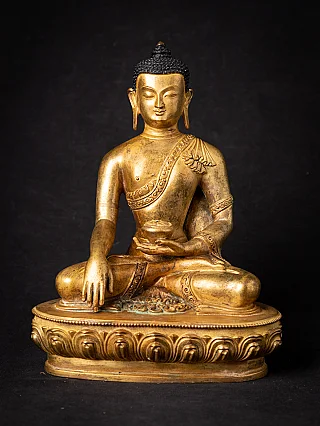
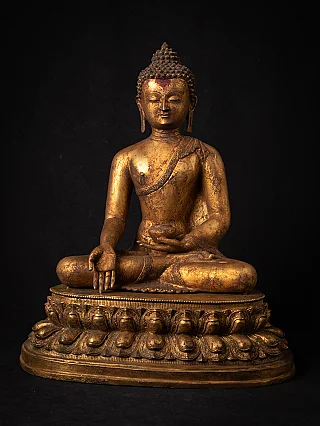
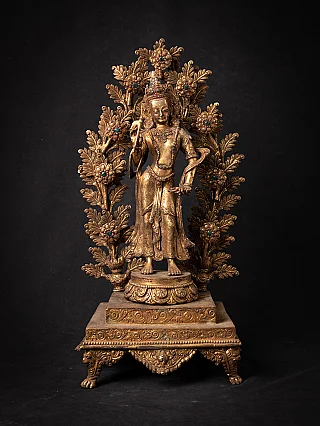
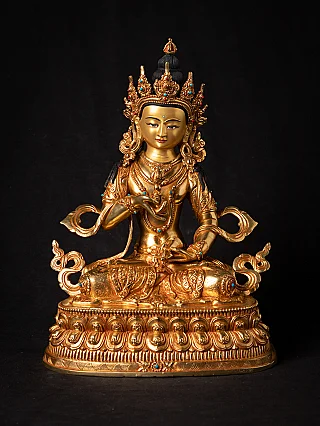
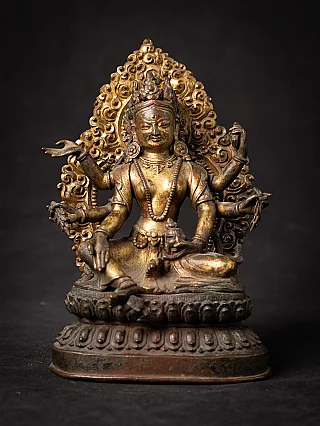
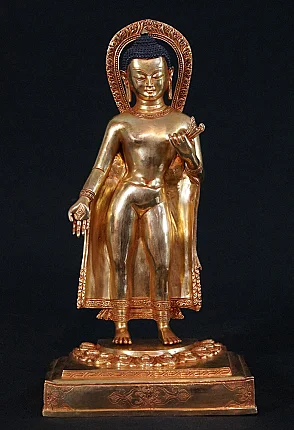
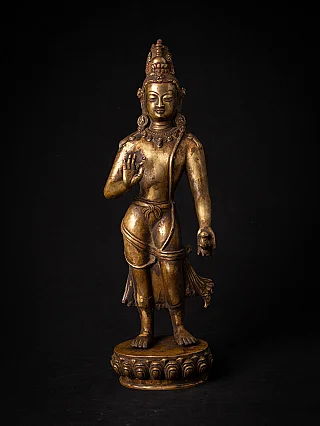
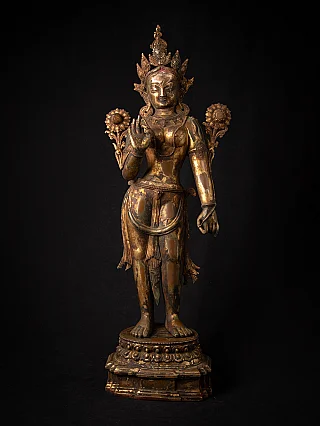
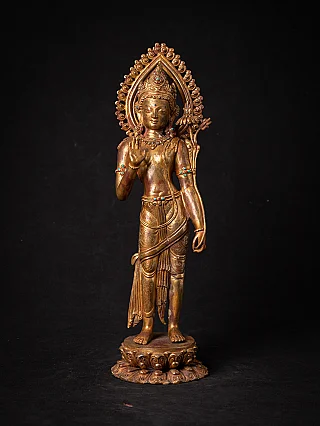
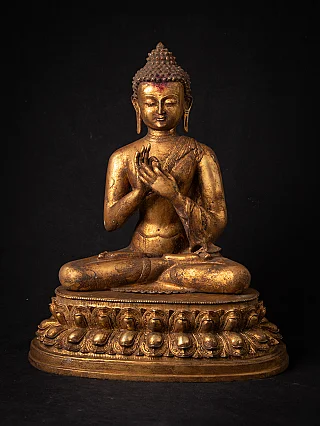
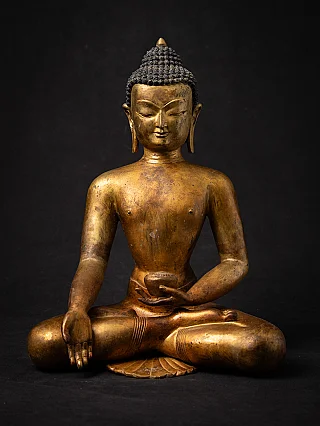
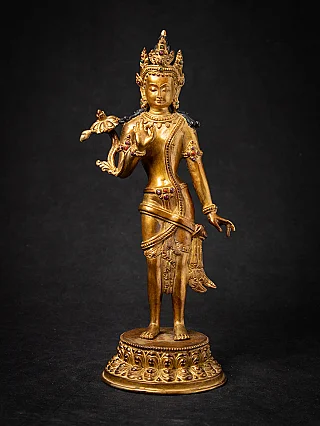
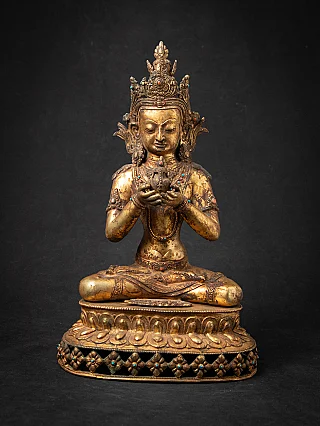
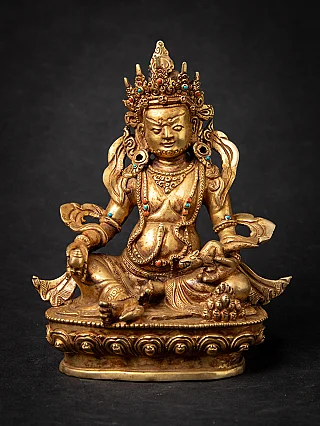
Once you know what to look for, a Nepali statue is often easy to recognise: refined metalwork, gold gilding or a warm reddish copper tone, rich jewellery and, on many later pieces, inlaid stones. Below we look at the metal, the surface, the face and the ornament, and at the Buddhas and deities you will meet most often.
Discover Nepali Buddha statues
What makes a Buddha statue Nepali?

No single detail proves that a statue comes from Nepal, so it pays to look at several things together. These are the five we check first.
1. The metal. The Newar people of the Kathmandu Valley have long specialised in casting metal figures with the lost-wax method. Lalitpur, also called Patan, is still known for its metal casting today. Read about bronze casting in Patan.
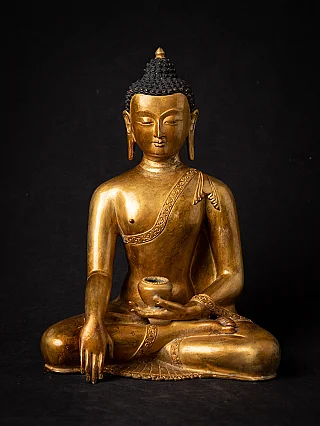
2. The surface. Nepali metal statues are often heavily gilded. Where the gold has worn away, the high copper content of the metal gives it a slightly reddish tone. Nepali bronzes are often fire gilded with 24 carat gold. Read why Buddha statues are gilded.
3. The face. Look for long, languid eyes and a face that is wider than in the sculpture of eastern India, where Nepali art has its roots.
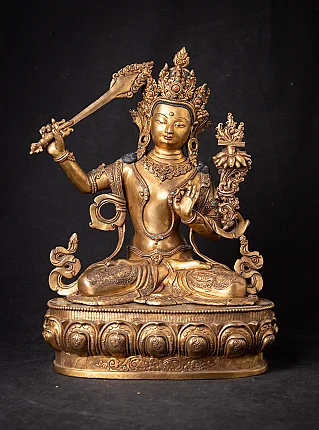
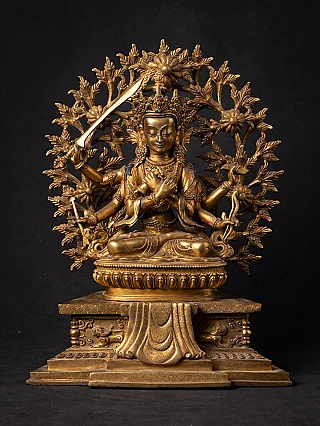
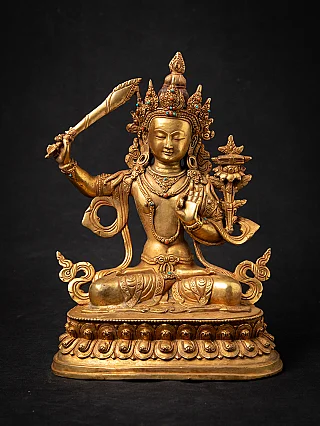
4. Ornament and pose. Nepali sculpture tends towards ornamental flourishes, exaggerated postures and jewellery styles of its own. Many later pieces are set with semi-precious stones.
5. Hands and attributes. Each Buddha and deity has its own hand gestures and objects to hold. The historical Buddha often shows the earth-touching gesture, the bhumisparsha mudra. More about hand positions.
Who is who in Nepali Buddhist art
Newar Buddhism is a form of Vajrayana, and the oldest known form of that tradition. That is why you meet many more Buddhas and deities in Nepali art than the historical Buddha alone. These are some of the best known.
- Shakyamuni, the historical Buddha, who was born in Lumbini in present-day Nepal.
- Amitabha, the Buddha of Limitless Light. When seated, he is often shown in the meditation gesture.
- The Medicine Buddha, holding a jar of medicine nectar in his left hand and the stem of a myrobalan fruit. In some versions his skin is blue. Read about the Medicine Buddha.
- Maitreya, the Buddha of the future, shown standing or seated on a throne. Read about Maitreya.
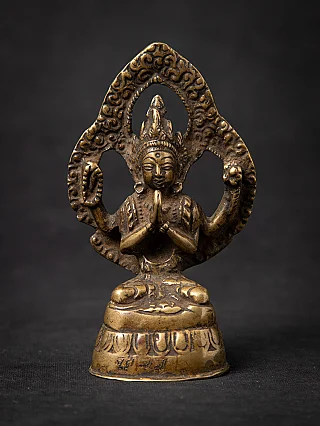
- Avalokiteshvara, the Bodhisattva of Great Compassion, also called Lokeshvara, and Chenrezig in Tibetan. He appears in many forms, one of them with four arms. Read about Lokeshvara and Avalokiteshvara.
- Manjushri, the Bodhisattva of wisdom, with a flaming sword in his right hand and a sutra on a lotus in his left. Read about Manjushri.
- White Tara, with eyes on her hands and feet and a third eye on her forehead, which is why she is called "seven-eyed". Read about White Tara.
- Vajrapani, the protector, with a wrathful face and a vajra in his right hand. Read about Vajrapani.
Newar artists make statues of Hindu gods as well as Buddhist ones. In the 2021 census, 81 percent of Nepalis were Hindu. See our Ganesha statues and all our Hindu god statues.
Nepali art through the ages
Nepali sculpture grew out of the art of Gupta India and was later influenced by Pala India. Nepali artists then created a style of their own.
Licchavi period (about 400 to 750)
The earliest period of Nepali sculpture. A statue of Vishnu as Trivikrama, set up by the Licchavi king Manadeva, is considered the oldest sculpture in Nepal.
Malla period (about 1201 to 1779)
The Malla kings supported both Buddhist and Hindu traditions, and casting techniques developed further. The style of metal sculpture kept changing until about the 17th century. After that it changed little, so the style of a statue alone cannot always tell you how old it is.
Newar artists abroad
As early as the 7th century, visitors noted the skill of Newar artists, whose work influenced the art of Tibet and China. The best known is Araniko, born in 1245. At just seventeen he led a team of 80 Newar artisans to Tibet to build a golden stupa ordered by Kublai Khan. He then went on to Kublai Khan's court, and he is known for building the White Stupa of the Miaoying Temple in Beijing.
Nepal and Tibet
Because Newar artists influenced Tibetan art for centuries, statues from Nepal and Tibet can look very much alike. Want to compare for yourself? Have a look at our Tibetan Buddha statues.
Materials and craft
Lost-wax casting
Newar metal statues are made with the lost-wax method. The figure is first modelled in wax and covered to make a mould. When the mould is heated, the wax melts and runs out, and molten metal is poured into the space it leaves. After casting, each statue is carved and polished by hand. See how it is done in our article on bronze casting in Patan, or browse our bronze Buddha statues.
Repoussé
Repoussé is also part of the Newar tradition. The metal is hammered from the back to form the figure in relief.
Fire gilding
For fire gilding, a mix of gold and mercury is applied to the metal. When it is heated, the mercury evaporates and the gold stays behind.
Painting
Newar painting, called paubha, is world-renowned as well. Read about thangka paintings.
Buddhism in Nepal
The Buddha was born in Lumbini, in the south of present-day Nepal. In the 2021 census, 81 percent of Nepalis were Hindu and 8 percent Buddhist. The great stupas of Swayambhunath and Boudhanath in the Kathmandu Valley draw visitors from all over the world. Read more about Buddhism in Nepal, Lumbini and Vajrayana Buddhism, or the old question: was the Buddha born in Nepal or India?
Our buying trips in Nepal
"Traveling through India and Nepal remains one of the most important ways to stay closely connected to the origins of sacred sculpture. Understanding regional materials and craftsmanship firsthand allows us to evaluate authenticity with greater precision."- Peter Vredeveld
Our family ties with Nepal mean we visit the country several times a year. In March 2026 Peter and Gaurav Manandhar travelled to Kathmandu and Lalitpur (Patan), the city known for its metal casting. On an earlier trip we visited Boudha, Patan and Swayambhu. Read about the trip in On the Ground in India and Nepal.
A video of our trip to Nepal in search of antique and original Buddha statues
Where our Nepali statues come from
We have specialised in antique Buddha statues for more than 20 years. We guarantee that the age and information we give for every statue are correct, and reproductions or 20th-century imitations are always described as such. We do not deal in stolen art. On request, we can provide a certificate of authenticity for a statue you have bought. Read our authenticity guarantee and our article on how to identify an antique Buddha statue.
Frequently asked questions
How can I tell if a Buddha statue is from Nepal?
Look at several features together: fine lost-wax casting, heavy gilding or a reddish copper tone, long eyes in a wide face, rich jewellery and, on later pieces, inlaid stones. No single detail settles it on its own.
How old is my Nepali Buddha statue?
The style of Nepali metal sculpture has changed little since about the 17th century, so style alone is often not enough. A good place to start is our article on how to identify an antique Buddha statue.
What is the difference between a Nepali and a Tibetan Buddha?
Newar artists influenced Tibetan art for centuries, so the two can look very much alike. Compare our Nepal and Tibetan statues side by side.
Why are so many Nepali statues gold?
Many Nepali metal statues are heavily gilded, often fire gilded with 24 carat gold. Where the gold has worn off, the reddish copper shows through.
Can I get a certificate of authenticity?
Yes. On request and after consulting with us, we can provide a certificate of authenticity for the statue you have bought.
Do you ship Nepali Buddha statues abroad?
Yes. We send statues from our gallery in Deventer, and delivery overseas is possible as well. Large or fragile pieces can be delivered and placed by us, also outside the Netherlands. See our order information.
Also from the Himalayas: Tibetan Buddha statues, singing bowls, thangkas and Hindu god statues.
Share this page