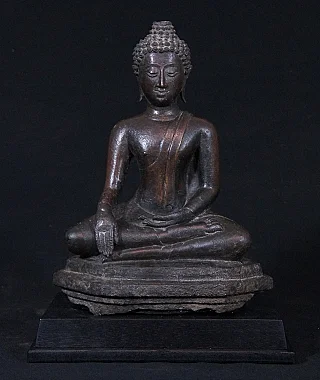
Sukhothai Buddha Statues: 13th to 15th Century
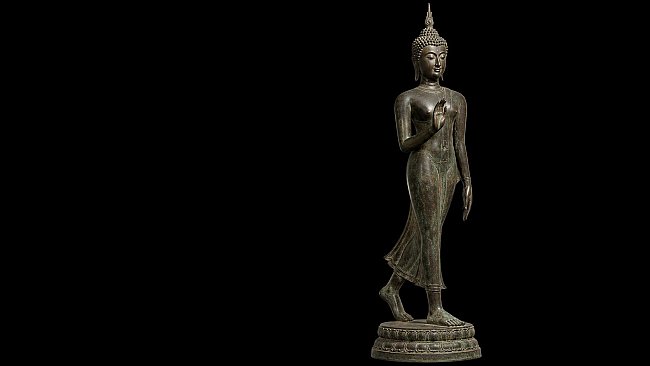
The Sukhothai period (13th to 15th century) is often called the golden age of Thai art. In the kingdom of Sukhothai, in what is now north-central Thailand, sculptors created a Buddha image unlike anything made before it: slender, smooth and almost weightless, with a flame rising from the top of the head. They also invented a pose that hardly exists anywhere else in Buddhist art, the walking Buddha.
Sukhothai Buddha statues set the standard for much of what came after in Thailand. Ayutthaya, Lanna and later Rattanakosin sculptors all borrowed from them, and Sukhothai-style Buddhas are still made today. Below we look at where the style came from, how to recognise it and what collectors should know.
The Sukhothai kingdom and Theravada Buddhism
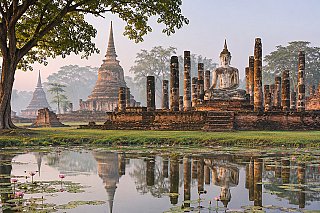
Sukhothai is regarded as one of the first Thai kingdoms. Around 1238, Tai leaders drove out the Khmer governors who controlled the city and founded an independent state. Under King Ramkhamhaeng, who ruled in the late 13th century, Sukhothai grew into a regional power.
The kings of Sukhothai embraced Theravada Buddhism from Sri Lanka, and monks and images from the island had a strong influence on local art. Instead of copying the crowned, regal Khmer Buddhas that stood in the region before, Sukhothai artists looked to Sri Lankan models and then developed their own ideal of the Buddha: calm, graceful and clearly not of this world.
From the late 14th century Sukhothai came under the growing power of Ayutthaya, and by 1438 it had become part of the Ayutthaya kingdom. Its artistic style lived on, however, and shaped Thai Buddha images for centuries.
How to recognise a Sukhothai Buddha statue
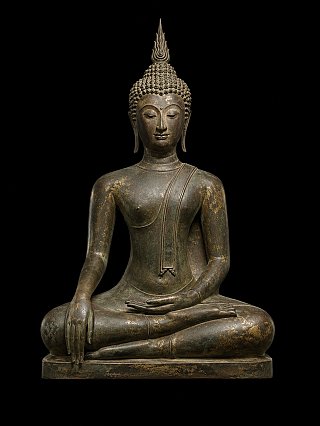
Once you know the signs, a Sukhothai Buddha is usually easy to pick out. These are the features we look at:
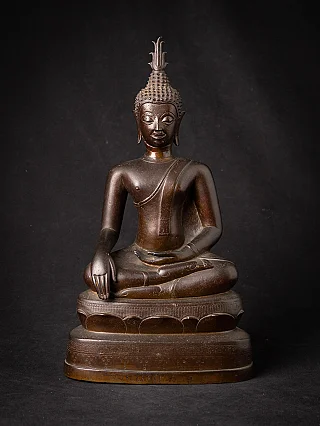
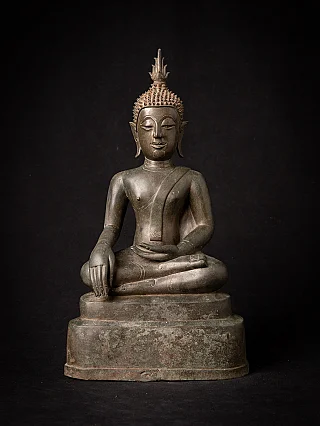
- The flame on the head: a tall, pointed flame (called rasmi in Thai) rises from the ushnisha, the bump on top of the head. This flame finial came from Sri Lanka and became a hallmark of Sukhothai art.
- The face: an oval face with a pointed chin, a hooked nose and a faint, inward smile. The eyebrows form a high, smooth arch that often meets above the nose, and the eyes look down.
- The hair: small, tight snail-shell curls, with no band between the hair and the forehead. That band is a feature of later U Thong and Ayutthaya statues.
- The ears: long earlobes that curve gently outwards at the bottom.
- The body: broad shoulders, a narrow waist and smooth, rounded limbs, with no visible muscles or bones. The figure seems to float rather than sit or stand.
- The robe: the robe clings to the body and is often barely visible, apart from a long flap that falls from the left shoulder to the navel and usually ends in a notched tip.
- The hands: long, slender fingers. In seated statues the right hand reaches down to touch the earth in the bhumisparsha mudra.
- The seat: seated Buddhas sit with the right leg resting on the left (half-lotus) on a fairly plain base, often without a decorated lotus pedestal.
The walking Buddha: Sukhothai's great invention
Most Buddha images across Asia sit, stand or lie down. Sukhothai sculptors added another posture: walking. The walking Buddha steps forward with one heel lifted, one arm swinging gently at the side and the other hand raised in front of the chest, usually in the abhaya mudra (no fear) or the vitarka mudra (teaching).
There was no Indian model for this pose. It is often linked to the story of the Buddha returning from the Tavatimsa heaven after teaching the Dharma to his mother, and it shows the Buddha as a teacher moving among people. Free-standing walking Buddhas are seen as the most original creation of Sukhothai art, and they are still made in Thailand today.
The four postures of the Buddha
Sukhothai is credited with establishing the four postures that are still standard in Thai Buddhist art:
- Seated, most often in the earth-touching gesture, recalling the moment of enlightenment.
- Standing, often with one or both hands raised.
- Walking, the posture unique to Thai art.
- Reclining, showing the Buddha at his passing into parinirvana. Read more about reclining Buddha statues.
Regional schools within Sukhothai art
Sukhothai art was not one single style. Art historians recognise several groups, including:
- The Phitsanulok or Chinnarat group: named after the famous Phra Buddha Chinnarat in Phitsanulok. These Buddhas have a rounder face and fingers of almost equal length, and large images are often framed by a flame-edged arch.
- The Kamphaeng Phet group: from the city of the same name, with a longer face and a broad forehead that narrows towards the chin.
- The Wat Ta Kuan group: an early group that stays close to Sri Lankan models, with a broader face and a sturdier body.
Sukhothai and Ayutthaya Buddha statues: the differences
Because Ayutthaya took over Sukhothai and copied its art, the two styles are easy to confuse. A few pointers:
- Sukhothai faces are oval and refined, while Ayutthaya faces are often broader and more stern.
- Sukhothai Buddhas have no band at the hairline, while most Ayutthaya Buddhas do.
- Sukhothai bodies are slender and fluid, while Ayutthaya bodies are often heavier and more stylised.
- Ayutthaya sculptors made many richly crowned and jewelled Buddhas, which are rare in Sukhothai art.
Read more about the Ayutthaya period and the later Rattanakosin period.
Sukhothai Buddha statues for collectors
Genuine Sukhothai bronzes from the 14th and 15th centuries are rare. Most are kept in temples and museums, and Thailand has strict rules on exporting antique Buddha images, so early pieces almost never come onto the market legally.
The Sukhothai style itself has never stopped being made. Sculptors of the Ayutthaya and Rattanakosin periods copied it, and many walking and seated Buddhas in Sukhothai style were cast in the 19th and 20th centuries. These later statues can be beautiful works in their own right, as long as they are described honestly. When we offer a Thai statue, we describe its age as accurately as we can, and we always follow the laws of the country it comes from.
Frequently asked questions
What is a Sukhothai Buddha?
A Buddha image made in the style of the Sukhothai kingdom in Thailand (13th to 15th century). You can recognise it by the flame-shaped ushnisha, the oval face and the slender, flowing body.
Why is the walking Buddha important?
The walking Buddha is a Thai invention of the Sukhothai period. It has no Indian model and shows the Buddha as a teacher moving among people.
What does the flame on top of a Thai Buddha mean?
The flame, or rasmi, stands for the radiance of the Buddha's wisdom and enlightenment. It came to Thailand from Sri Lanka and became a defining feature of Sukhothai art.
Are Sukhothai-style Buddha statues still made today?
Yes. The style has been copied ever since the Sukhothai period, and many statues in Sukhothai style were made in later centuries and in modern times.
Share this page