Om (Aum): The Sacred Chant of Hindu Religion
Author : Peter Vredeveld · Published

Om or Aum, a venerable symbol in Hindu spirituality, holds deep significance as a cosmic resonance and a transformative mantra. Embraced globally, Om / Aum is intrinsic to the spiritual and cultural fabric of Hinduism, tracing its roots to ancient Indian scriptures such as the Upanishads and the Bhagavad Gita. Revered as the primordial sound of creation, resonating with the eternal rhythm of existence, "Om" encapsulates the three states of consciousness—waking, dreaming, and deep sleep. It also symbolizes the Hindu triad of Brahma, Vishnu, and Shiva. As the embodiment of cosmic vibration, Om/Aum unifies individuals with the universe, guiding seekers on an inner journey towards spiritual growth and self-realization. Devotees who engage in chanting Om/Aum seek inner tranquility, mental clarity, and a profound connection with the divine. This sacred syllable transcends time and culture, persisting as an ageless expression of unity, consciousness, and the eternal pursuit of enlightenment.
Exclusive Hindu God statues and arts
The Symbol "Om"

Om/Aum visually appears as a sacred symbol in Indian scripts, featuring three curves and a dot. Symbolizing the three primordial sounds—"A," "U," and "M"—each curve holds symbolic significance: "A" for creation, "U" for preservation, and "M" for destruction. The dot indicates the unmanifested, the source of creation and dissolution.
Interpretation of the Triadic Syllables
The syllables "A," "U," and "M" in Om/Aum carry profound meanings:
- "A" represents the waking state of consciousness, signifying the beginning and creation.
- "U" symbolizes the dream state, embodying preservation and continuity.
- "M" signifies deep sleep and the state of dissolution, representing a return to the source.
The combination of these syllables reflects the cyclical nature of existence and the eternal cosmic dance of creation, preservation, and dissolution.
Connection to the Ancient Sanskrit Language
Om/Aum finds its origins in the ancient Sanskrit language, known for its precision and richness. The phonetic structure of Om/Aum is considered the most fundamental sound representing all possible sounds in the universe. It is believed to be the primal sound from which all other sounds and languages emerged, embodying cosmic vibrations.
Om/Aum in Hinduism

In Hinduism, Om/Aum is the most sacred syllable, embodying the divine cosmic sound. Mentioned in ancient Hindu scriptures like the Upanishads and the Bhagavad Gita, Om/Aum is regarded as the primordial sound of creation and the universe. It is often chanted at the beginning and end of Hindu rituals, symbolizing the cyclical nature of existence and the eternal rhythm of life.
Om/Aum in Buddhism
Buddhism has adopted the chanting of Om/Aum as a potent mantra with profound spiritual significance. Widely used in meditation practices across various Buddhist schools, the sound of Om/Aum is believed to resonate with the rhythm of the cosmos, harmonizing the mind and body and guiding practitioners toward enlightenment (Nirvana).
Universal Appeal of Om/Aum
The power and universal appeal of Om/Aum extend beyond Indian religions, captivating seekers worldwide. Embraced by diverse spiritual communities, including yoga practitioners and those seeking mindfulness, Om/Aum resonates with its ability to connect individuals to the cosmic vibration and the essence of existence.
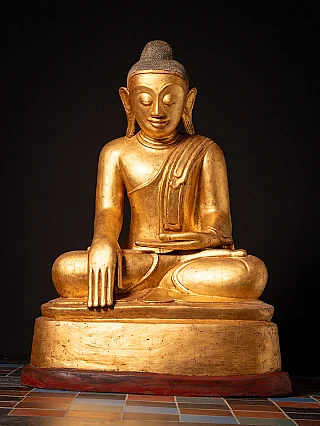
Our exclusive Buddha statues pieces
Scientific and Philosophical Perspectives

Om/Aum has piqued interest from researchers exploring its acoustic properties and effects on the mind and body. Philosophically, it is seen as a representation of consciousness and the interconnectedness of all beings. Neuroscientific studies suggest that chanting Om/Aum may calm the brain, promoting relaxation and stress reduction.
Cultural Representations of Om/Aum
Throughout history, Om/Aum has been artistically depicted in ancient scriptures, art, and architecture. It features prominently in religious rituals, ceremonies, and festivals, signifying its enduring spiritual and cultural significance. The symbol is widely embraced to represent India's rich cultural heritage.
Conclusion
Om/Aum stands as a timeless and universal symbol, embodying the essence of cosmic reality and the eternal quest for spiritual connection. Its power to transcend religious boundaries and resonate with seekers worldwide is a testament to its profound and transformative nature. Embracing the deeper meanings of Om/Aum, readers are encouraged to explore its spiritual essence and uncover the wisdom it holds, transcending cultural, religious, and temporal boundaries. The sacred syllable Om/Aum remains an enduring expression of unity, consciousness, and the eternal journey towards enlightenment.
Share this page