

White Tara: The Seven Eyes, Healing Presence, and Compassion
Author : Peter Vredeveld
White Tara holds a distinctive place within Buddhist art and symbolism. She is neither distant nor abstract, but represented as attentive, calm, and quietly responsive. Her image speaks of compassion that sustains life and clarity over time, rather than dramatic intervention or forceful action.
Across Himalayan and Tibetan traditions, White Tara is understood through the visual language of her form. Each detail carries meaning, inviting careful observation and reflection.
Who Is White Tara?
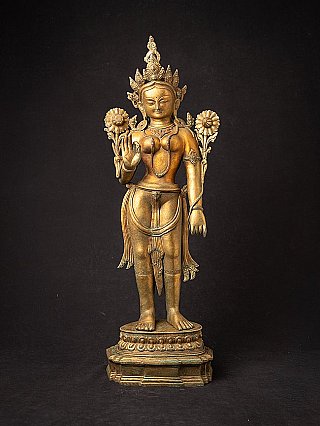
White Tara is a bodhisattva, a figure who has attained deep wisdom while choosing to remain engaged with the world. Instead of withdrawing from life, a bodhisattva responds to suffering wherever it appears.
White Tara is closely associated with healing, longevity, and mental clarity. In Buddhist thought, longevity does not imply endless life, but rather the preservation of conditions that allow understanding, compassion, and awareness to continue developing.
Her presence reflects a steady and reassuring care, offering support rather than urgency.
The Meaning of the Color White
Color plays an important role in Buddhist art. White symbolizes purity, balance, and clarity. In the context of White Tara, it also conveys healing and completeness.
White is not emptiness or absence. It represents harmony and calm awareness, reinforcing her role as a stabilizing presence within the world.
The Seven Eyes of White Tara
One of White Tara’s most recognizable features is her seven eyes. She is shown with two eyes on her face, one on her forehead, and one on each hand and foot.
These eyes symbolize compassion that is fully aware. They express the idea that suffering appears in many places and in many forms, and that true compassion sees without limitation.
In Buddhist art, this imagery communicates that awareness and action are inseparable. To truly see suffering is also to respond to it.
The placement of eyes on the hands and feet emphasizes that compassion moves into the world through care, movement, and presence.
What the Seven Eyes Represent
Interpretations vary across traditions, but the seven eyes are often understood as representing:
- Awareness of suffering in all directions
- Attentiveness to physical, emotional, and inner distress
- Compassion expressed through action
- Insight that guides how one moves through the world
- A reminder that seeing and responding are connected
Rather than functioning as decoration, the eyes form a visual teaching that invites slow and thoughtful observation.
Posture and Gesture
White Tara is most commonly depicted seated in a stable posture. This conveys calm attentiveness and balance, reflecting compassion expressed through presence rather than motion.
Her right hand often displays a gesture of generosity, while her left hand holds a lotus flower. The lotus symbolizes purity and awakening arising within the conditions of life, untouched by confusion or turmoil.
Together, posture and gesture communicate reassurance, clarity, and quiet strength.
Healing and Longevity
White Tara is traditionally associated with healing and long life. In this context, healing is understood as restoring balance and clarity, rather than eliminating difficulty.
Longevity refers to sustaining the conditions necessary for wisdom and compassion to grow. It emphasizes continuity, steadiness, and care maintained over time.
In Himalayan Buddhist traditions, White Tara imagery has long been present in spaces of contemplation and daily life, offering support through calm presence rather than dramatic symbolism.
White Tara Among Other Bodhisattvas
White Tara appears alongside other bodhisattvas who express compassion and wisdom in different ways.
- Avalokiteshvara represents compassion in its broadest form.
- Green Tara is associated with swift response and protection.
- Manjushri embodies insight and clarity of understanding.
- White Tara emphasizes nurturing care, healing, and sustained awareness.
Together, these figures show that compassion is not singular, but responsive to different needs and circumstances.
White Tara in Buddhist Art
Images of White Tara are found throughout Nepal, Tibet, and the Himalayan regions in various forms, including bronze, stone, and painted representations. Sculptors focused on balance, proportion, and subtle expression to convey her qualities.
These works were created as objects of contemplation rather than decoration. Their purpose was to be lived with, observed over time, and approached with attention.
White Tara’s imagery rewards slow looking, revealing layers of meaning through form rather than narrative.
White Tara Today
White Tara continues to resonate because her image speaks to a form of compassion that remains present without haste. In a fast-moving world, her calm and attentive presence offers a reminder that care can be steady, grounded, and enduring.
Her visual language encourages reflection on how compassion functions in daily life, not as a reaction, but as a sustained way of being.
Share this page


