Buddha Statues from Burma (Myanmar): How to Recognise Them
By Peter Vredeveld, collector of Buddhist art
Most of the statues in our gallery in Deventer come from Burma, the country now officially called Myanmar. Peter's trade in Buddhist art began in Burma more than twenty years ago, and thousands of Burmese Buddhas have passed through our hands since then.
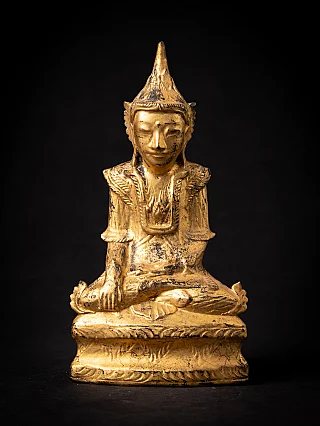
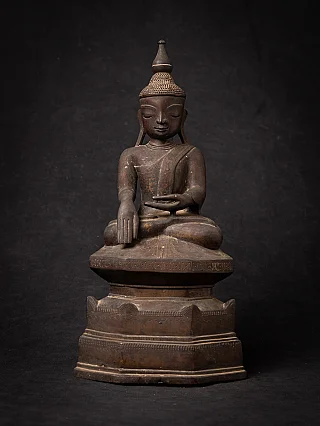
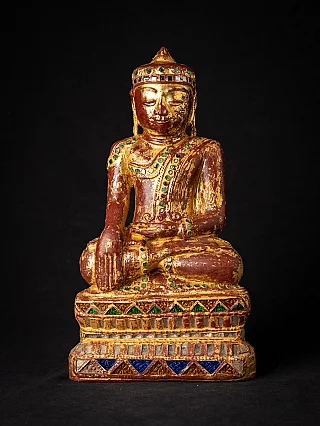
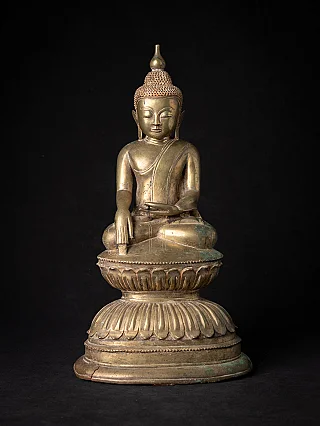
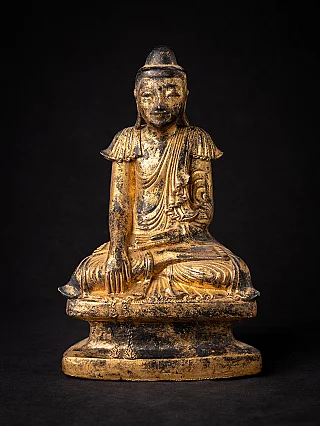
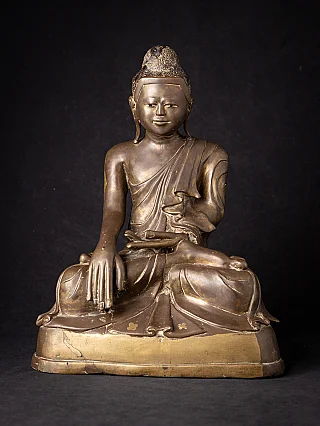
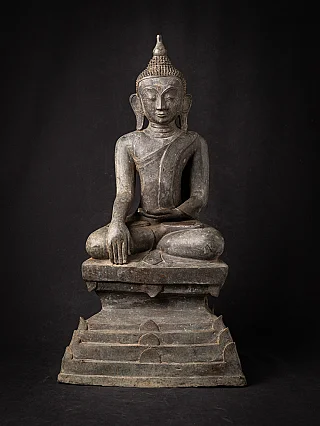
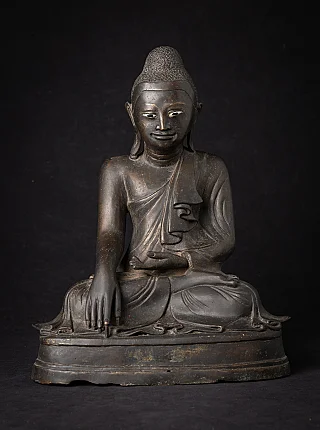
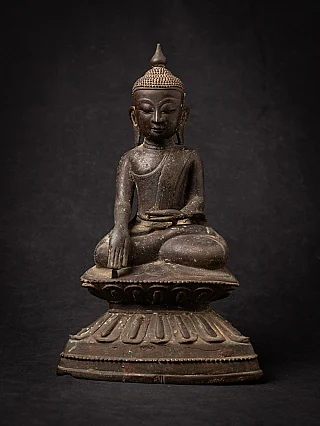
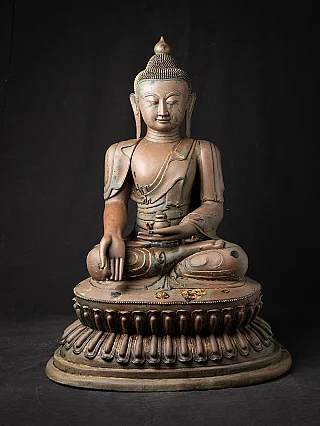
Once you know what to look for, a Burmese Buddha is usually easy to spot: a calm face with lowered eyes, the right hand reaching down to touch the earth and, on later pieces, a band across the forehead or a tall jewelled crown. Below we look at the face, hands, robe, base and surface, and at how they changed from the early Pyu city-states to the Mandalay period.
See our Burmese Buddha statues
What makes a Buddha statue Burmese?
No single detail proves that a statue is Burmese, so it pays to look at several things together. These are the six we check first.
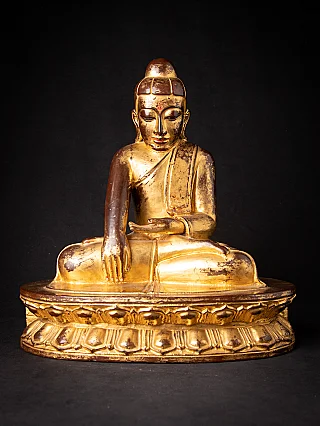
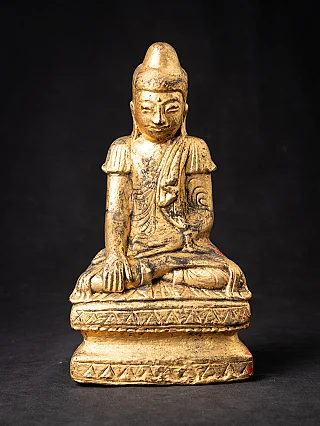
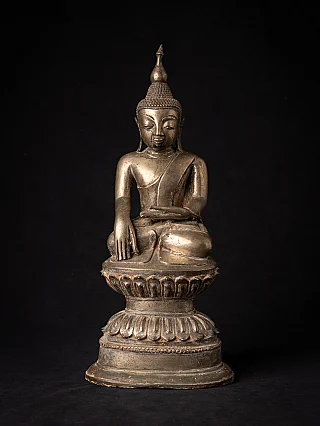
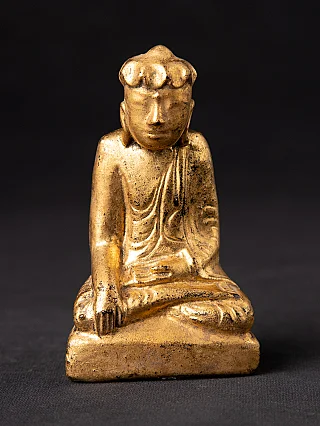
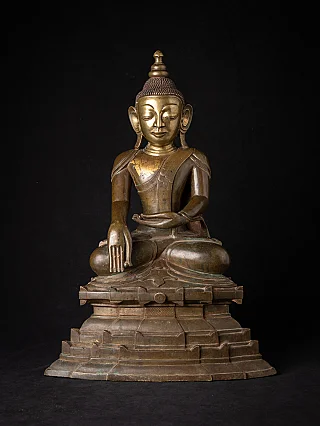
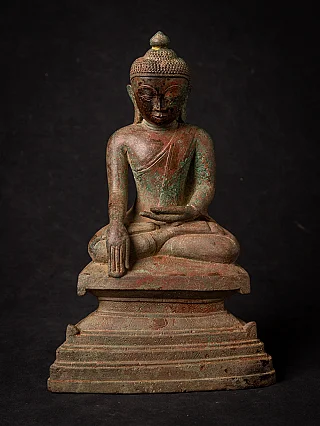
1. The earth-touching gesture. Most Burmese Buddhas sit in the bhumisparsha mudra. The right hand rests over the right knee with the fingers pointing to the ground, and the left hand lies open in the lap. The gesture recalls the moment the Buddha called the earth to witness his enlightenment. Other hand positions do occur, but far less often.
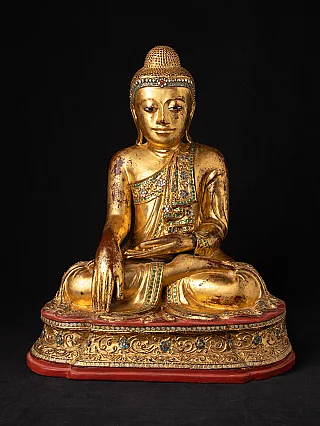
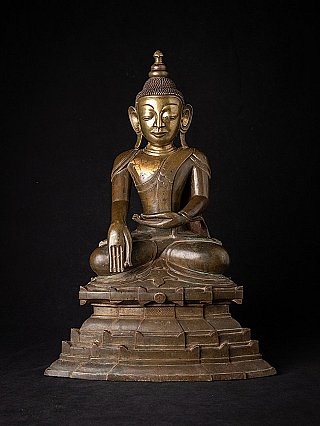
2. The face. Faces change a lot from one period to the next, which makes the face the most useful clue for dating. Bagan faces are broad and serene. Ava faces have heavy, half-closed eyelids and long earlobes that flare outward at the bottom. Shan faces are more angular, with a small mouth. Mandalay faces are full, rounded and youthful.
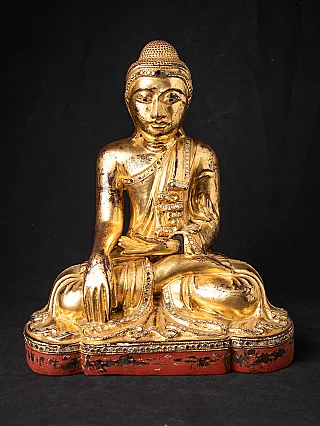
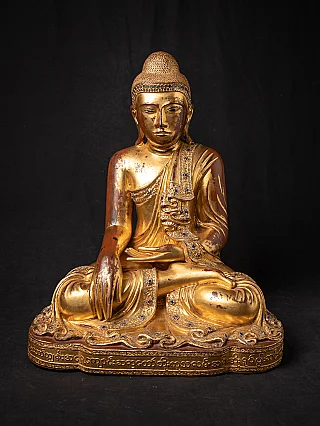
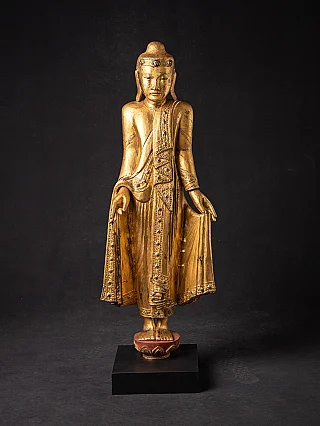
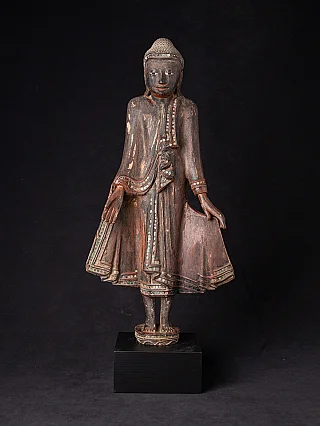
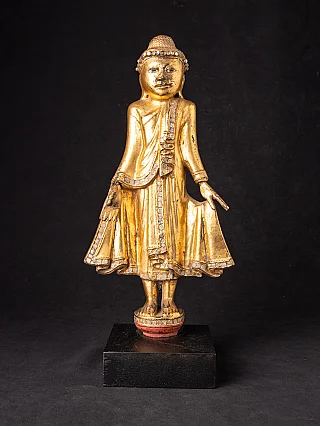
3. The head and hair. The hair is shown as small curls. On top sits the ushnisha, the raised mound on the crown of the head, often finished with a small finial or a lotus bud. Mandalay-period statues have a flat band across the forehead that separates hair and face, and it is one of the quickest ways to recognise them. Ever wondered what those curls are? Read what is on the Buddha's head.
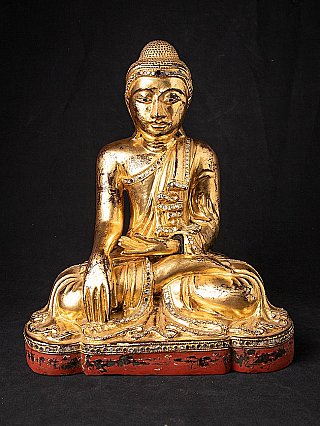
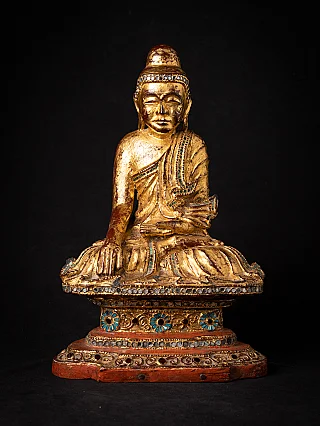
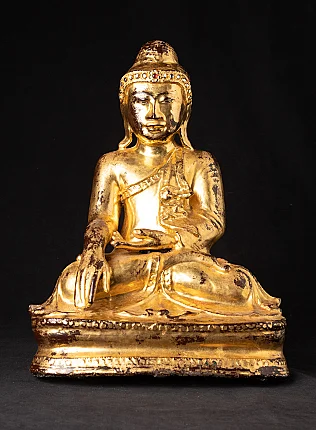
4. The robe. On seated figures the robe usually covers the left shoulder and leaves the right shoulder bare, while standing figures often have both shoulders covered. Early statues show a smooth robe that clings to the body. Mandalay robes have deep, flowing folds and decorated hems, often set with small pieces of coloured glass.
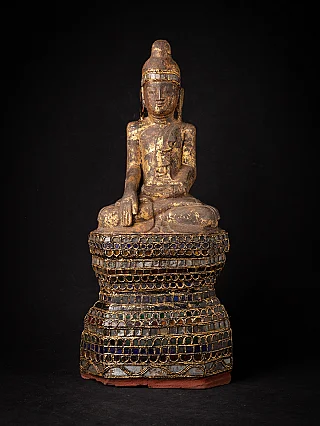
5. The base. Burmese Buddhas sit on stepped or waisted thrones and on lotus bases. Later thrones can be richly decorated with carving, lacquer relief and glass inlay. Our article on what a Buddha statue stands on explains the symbolism.
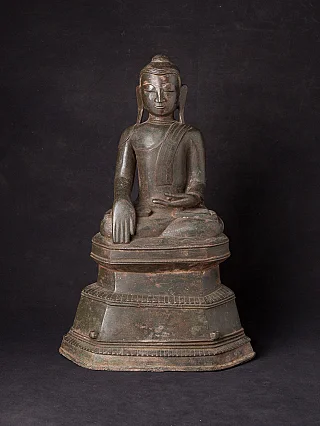
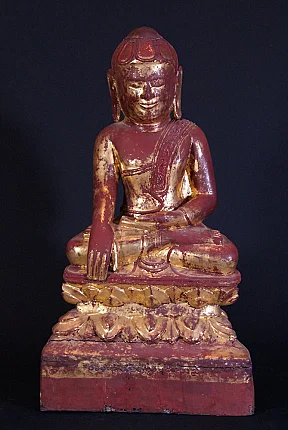
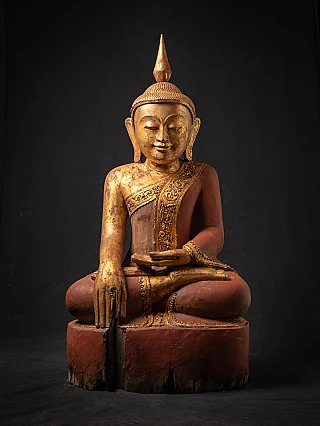
6. The surface. Many Burmese statues, in wood as well as bronze, were coated with lacquer and then covered in gold leaf. On old bronzes you can often still find traces of that red or black lacquer. Worn gilding on the knees, face and hands, where worshippers touched the statue, is a normal sign of age.
Burmese Buddha periods and styles
Burmese Buddhas are usually described by the period or the region they come from. The dates below are the ones we use in our collection. Styles overlapped, and workshops went on making older styles long after a kingdom had ended, so the style of a statue does not always tell you its age. Each period has its own page with more background, and you will find an overview of all regions under Buddha statue styles and periods.
Pyu period (3rd to 9th century)
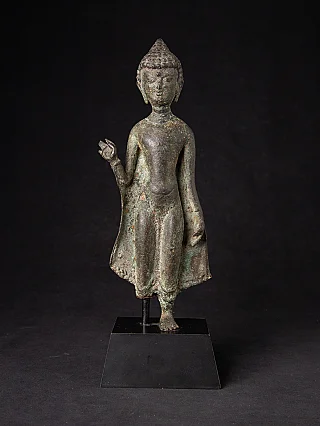
The oldest Buddha images in Burma were made in the Pyu city-states and show strong Indian influence. Pyu pieces are very rare. More about Pyu period Buddha statues.
Mon style (lower Burma)
The Mon kingdoms in the south of the country were among the first in the region to follow Theravada Buddhism, and their art had a strong influence on Bagan. More about Mon period Buddha statues.
Bagan period (1044 to 1347)
The first great Burmese kingdom, and the age of the temple plain at Bagan. Bagan Buddhas have broad shoulders, a solid body and a round, serene face, and they almost always show the earth-touching gesture. Read about Bagan period Buddha statues or see the Bagan-style Buddhas in our collection.
Toungoo period (1347 to 1596)
Often called Burma's golden age, when the Toungoo kings brought much of the country together again. In our classification it forms the bridge between Bagan and the later Ava style. More about Toungoo period Buddha statues.
Ava period (1618 to 1789)
Named after the royal city of Ava (Inwa), close to present-day Mandalay. Look for heavy eyelids, long earlobes that flare outward at the bottom and a stepped base. Read about Ava period Buddha statues or see the Ava-style Buddhas in our collection.
Amarapura period (1789 to 1853)
Amarapura was the royal capital for much of this time. Its statues lead towards the Mandalay style, with fuller faces and richer decoration. More about Amarapura period Buddha statues.
Mandalay period (1853 to 1948)
The last royal style of Burma, and the one you will see most often. A band across the forehead, a full and youthful face, deeply folded robe hems, glass inlay and gold leaf make these statues easy to recognise. Read about Mandalay period Buddha statues or see the Mandalay-style Buddhas in our collection.
In the video below, Peter shows the signs of a Mandalay Buddha on a white marble Buddha from our collection, carved in Mandalay from a single block of stone.
Shan style (eastern Burma)
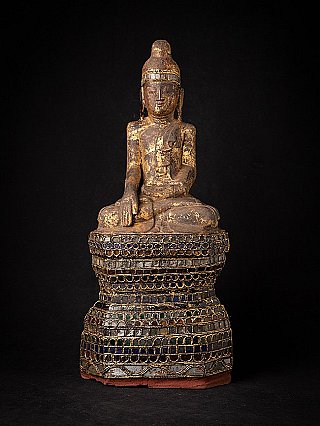
From the Shan States in the east of the country, home of the Tai Yai people. Shan Buddhas have an angular face, long ears, a small mouth and a tall, tapering ushnisha, and they are often made of wood or lacquer. Many sit on high thrones decorated with glass inlay. Read about Shan Buddha statues or see the Shan Buddhas in our collection.
Arakan (Rakhine) style (western Burma)
Arakan, on the west coast, was an independent kingdom until 1784 and is the home of the Mahamuni tradition. Crowned Buddhas are typical of the region. Read about Arakan Buddha statues or see the Arakan Buddhas in our collection.
Burmese or Thai? A quick check
Burmese and Thai Buddhas are easily confused. Both countries follow Theravada Buddhism and both favour the earth-touching gesture. Three things help:
- Top of the head: Thai Buddhas from the Sukhothai, Ayutthaya and Rattanakosin periods usually end in a tall, flame-shaped finial. Most Burmese Buddhas have a smaller finial or a lotus bud. Shan pieces, with their tall tapering ushnisha, are the exception.
- Body: Thai figures tend to be slender and elongated. Later Burmese figures are fuller and rounder.
- Forehead: a flat band across the forehead points strongly to Mandalay-period Burma.
Want to compare for yourself? Have a look at our Thai Buddha statues.
Crowned Buddhas and other Burmese forms
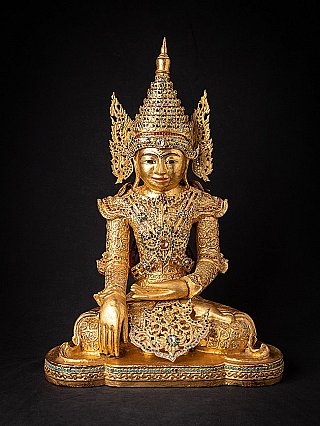
Next to the plain-robed Buddha, Burmese workshops made several other forms that collectors come across:
- Crowned Buddhas. The Buddha wears a tall jewelled crown and royal dress. In Burma this form is linked to the story of King Jambupati, a proud ruler who was humbled when the Buddha appeared to him in royal splendour. Crowned images are typical of Arakan and of the later Konbaung period, including Mandalay. Read about the Jambupati Buddha or see our crowned Buddha statues.
- The Mahamuni image. Burma's most revered statue. King Bodawpaya took it from Arakan in 1784, and today it sits in the Mahamuni Pagoda in Mandalay, where pilgrims have covered its body in so much gold leaf that the original shape is hard to make out. Read more about the Mahamuni Buddha image.
- Reclining Buddhas show the Buddha's passing into final nirvana. More about reclining Buddha statues.
- Monks and disciples, often kneeling with folded hands beside a Buddha. More about Buddhist monk statues.
- Nats are the spirits of Burmese folk belief. The best known are the 37 great nats, usually shown in court dress. More about Burmese nats.
Materials: bronze, wood, lacquer and alabaster
The material tells you a lot about where and when a Burmese statue was made.
Bronze
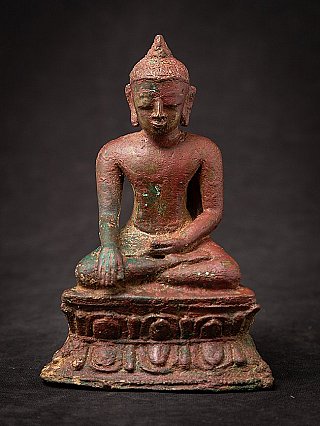
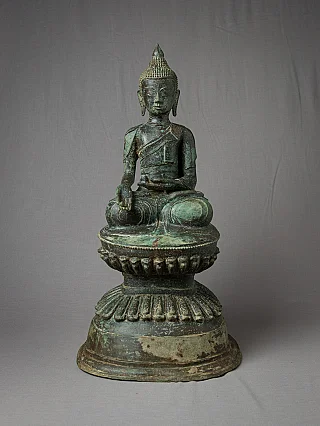
Bronze Buddhas were cast with the lost-wax method and were often lacquered and gilded afterwards. Old bronzes show natural wear and patina on the high points, and sometimes traces of the original lacquer, like the early bronze shown here. Read about bronze Buddha statues or browse our bronze Buddhas.
Wood
Usually teak, carved, lacquered and covered with gold leaf. With age you see fine cracks, worn gilding and red or black lacquer showing through. Read about wooden Buddha statues or browse our wooden Buddhas.
Lacquer
Burma has one of Asia's great lacquer traditions. Lacquer was used to seal and decorate statues, to hold the gold leaf and to model fine details in lacquer putty, known as thayo. Some Buddhas, especially Shan pieces, are built up largely from lacquer. Read about Burmese lacquerware or see our lacquerware.
Alabaster and marble
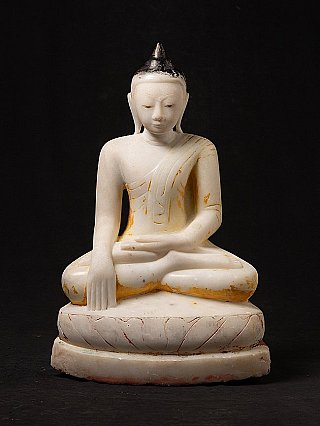
The white stone comes from the Sagyin hills north of Mandalay and was carved in Mandalay workshops, often painted or gilded afterwards. In the trade it is usually called alabaster, although strictly speaking it is a fine marble. Read about marble Buddha statues.
Buddhism in Burma
Close to nine out of ten people in Burma are Buddhist, and nearly all of them follow Theravada Buddhism. The Buddha image is part of daily life, in pagodas, monasteries and home altars. The temple plain of Bagan, with its thousands of stupas, shows how central Buddhist art has been here for a thousand years. Read more about Theravada Buddhism in Burma and about Bagan.
Our buying trips in Burma
"The Buddhas from Burma have a special character. A truly fine Buddha emanates immense power. I can look at them for hours. You can really see the amount of time and energy that has gone into making these statues."- Peter Vredeveld
Burma is where it all started for Peter, and over the years he has built up a network of collectors and traders there. Buying in a country like Burma and getting the statues out is not always easy. But when a Buddha finally arrives in the Netherlands, you have something truly special.
Restoring damaged statues
We sometimes buy damaged Buddha statues in Burma and have them restored on the spot by local craftsmen, with traditional lacquer and gilding. The film below shows how it is done.
Have a statue of your own? Read how to care for your Buddha statue, and more about the craft in our article on restoring and preserving Buddha statues.
Where our Burmese statues come from
We never remove statues from places of worship, and we do not buy antiques in Burma, because that is not allowed. We guarantee that the age and information we give for every piece are correct. Read our authenticity guarantee and our article on how to identify an antique Buddha statue.
Frequently asked questions
How can I tell if a Buddha statue is Burmese?
Look at several features together: the earth-touching gesture, the shape of the face and ears, a band across the forehead (Mandalay period), the robe folds and the stepped or decorated base. No single detail settles it on its own.
How old is my Burmese Buddha statue?
The style gives a first idea of the period, but statues were often made in an older style long afterwards. Wear, surface and construction help to narrow it down. A good place to start is our article on how to identify an antique Buddha statue.
What is the most common pose for a Burmese Buddha?
The seated Buddha in the earth-touching gesture, the bhumisparsha mudra.
Why do some Burmese Buddhas wear a crown?
Crowned Buddhas show the Buddha in royal splendour, which in Burma is linked to the story of King Jambupati. They are typical of Arakan and of the Mandalay period.
Can I buy an antique Burmese Buddha legally?
Myanmar does not allow antiques to be exported without permission, so always ask a dealer where a piece comes from. We never take statues from places of worship and never buy antiques in Burma. See our authenticity guarantee.
Do you ship Burmese Buddha statues abroad?
Yes. We send statues from our gallery in Deventer, and delivery overseas is possible as well. Large or fragile pieces can be delivered and placed by us, also outside the Netherlands. See our order information.
View all Burmese Buddha statues
Also from Burma: Burmese nat statues, offering vessels, opium weights, temples and shrines and Kammavaca manuscripts.
Share this page