Buddha Statues from Indonesia: How to Recognise Them
By Peter Vredeveld, collector of Buddhist art
Indonesia is home to Borobudur, the largest Buddhist monument in the world, built on the island of Java more than twelve hundred years ago. Java is also a land of volcanoes, and the dark volcanic stone they produce has been carved into Buddhas and Hindu gods ever since.
Most of the Indonesian pieces in our gallery in Deventer are lava stone statues from Java: Buddhas, Bodhisattvas and Hindu gods carved in the classical Javanese style, some from the middle of the 20th century and many made by today's stone carvers. Below we look at the stone, the face, the hands and the base, and at how Buddhist art in Indonesia developed from Borobudur to the workshops of today.
What makes a Buddha statue Indonesian?
No single detail proves that a statue comes from Indonesia, so it pays to look at several things together. These are the six we check first.
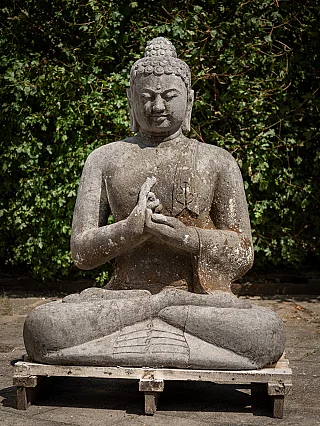
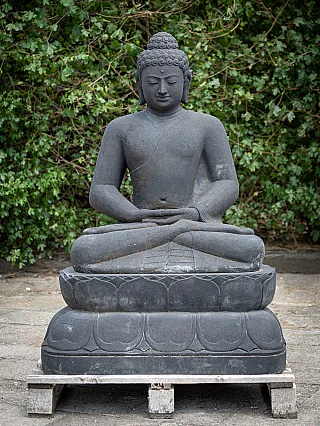
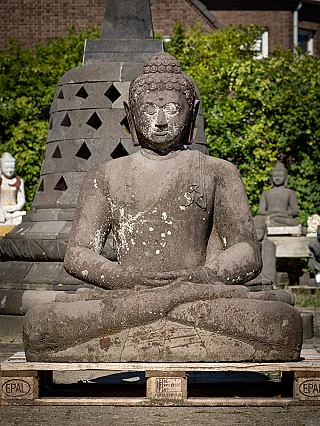
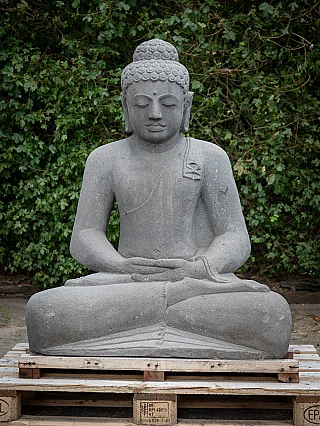
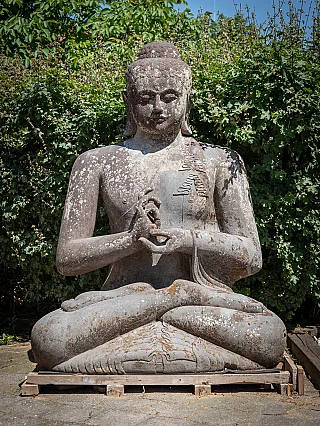
1. The stone. Most Indonesian statues are carved from lava stone, a grey to almost black volcanic rock with a fine, slightly porous surface. Outdoors it slowly weathers to soft grey and green, often with moss in the hollows. Read more about lava stone Buddha statues.
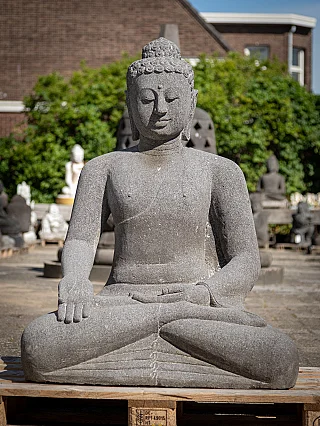
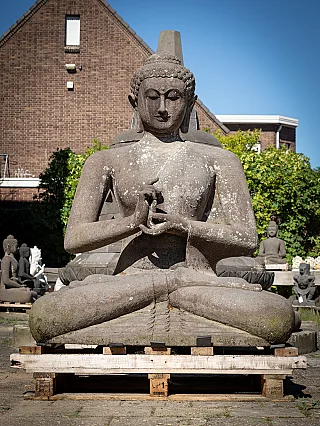
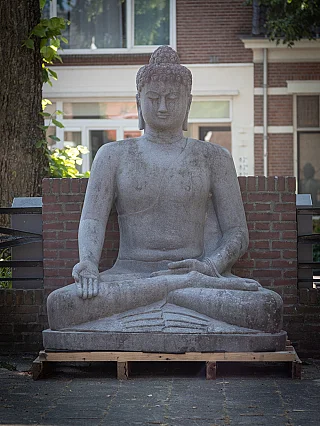
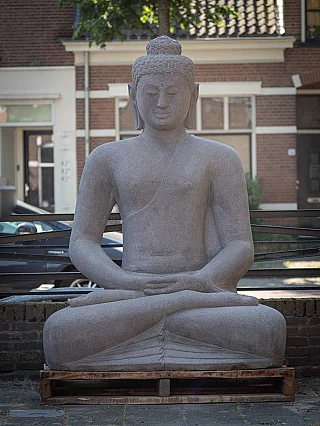
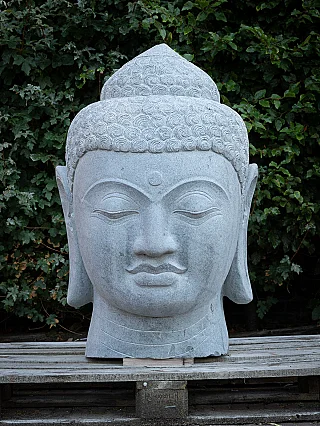
2. The face and head. Javanese Buddhas have a round, gentle face with half-closed eyes and a calm, inward smile. The hair is a cap of small tight curls, and the ushnisha on top of the head is low and rounded. There is no flame on top, as on Thai Buddhas.
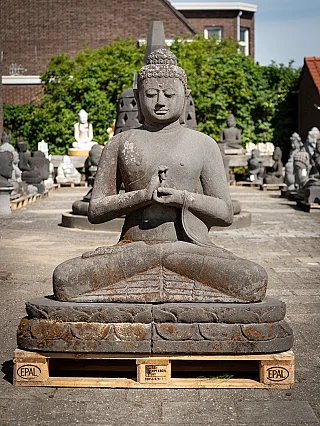
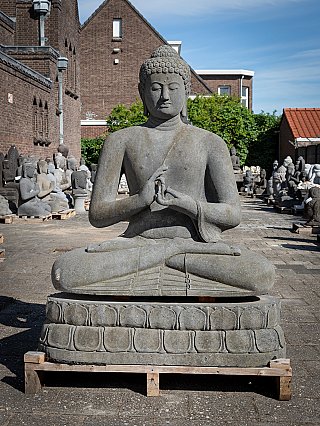
3. The body and robe. The body is smooth and full, and the robe is so thin that you mostly see it only at the hem, at the neck and on the left arm. Seated Buddhas sit in the lotus position with both soles turned upwards.
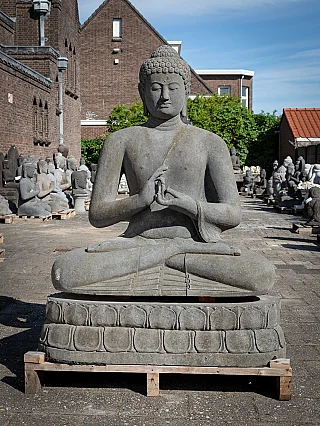
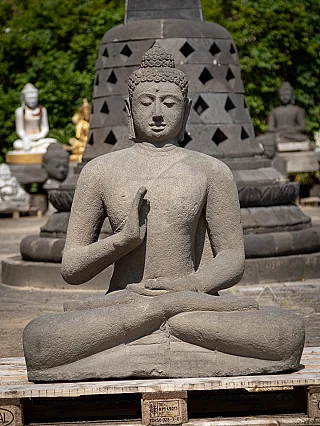
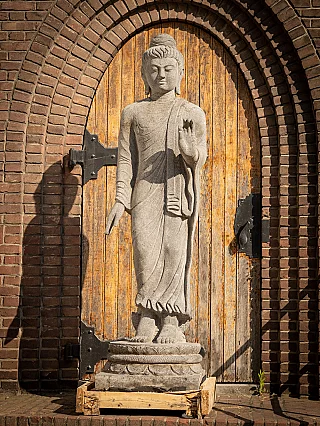
4. The hands. At Borobudur each side of the monument has its own gesture, and Javanese carvers still use the same set: the earth-touching gesture, the gesture of giving or varada mudra, meditation or dhyana mudra, reassurance, teaching or vitarka mudra and turning the wheel of the law or dharmachakra mudra.
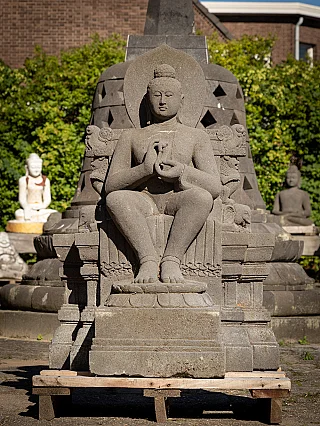
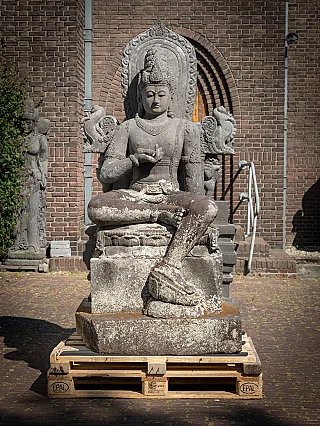
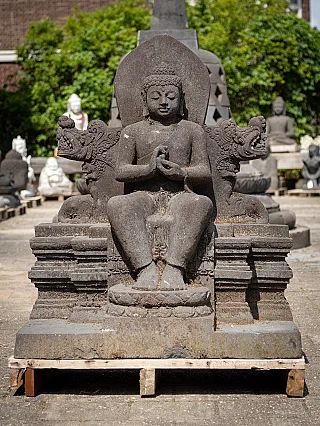
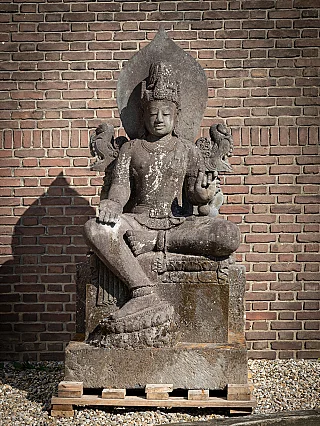
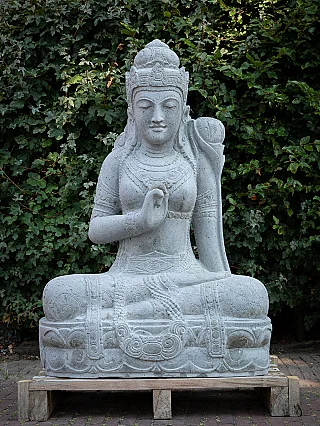
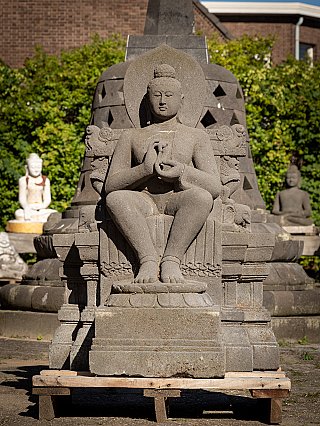
5. The base and back slab. Figures often sit on a double lotus cushion. Standing figures and Bodhisattvas are usually carved against a back slab with a rounded or pointed top, sometimes with a halo of flames around the head.
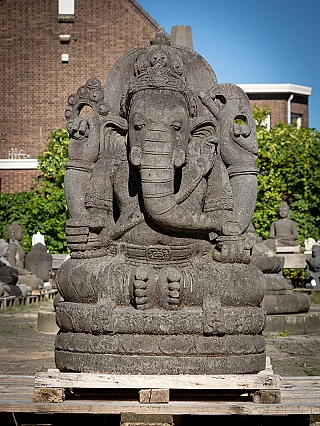
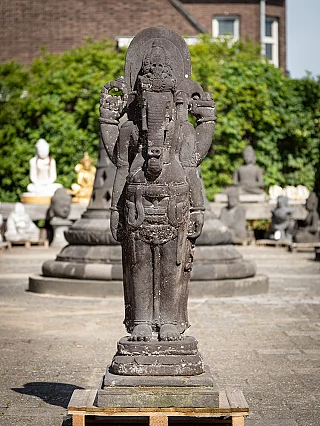
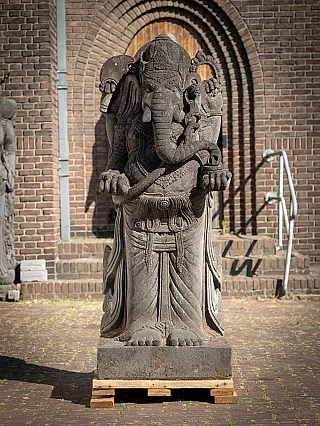
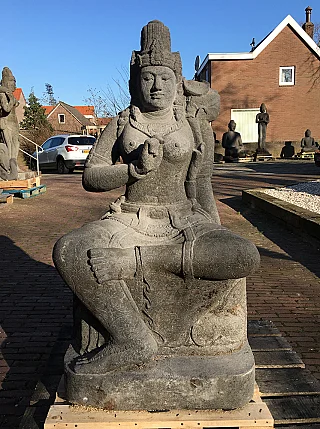
6. Hindu and Buddhist together. Java's old kingdoms were both Hindu and Buddhist, so the same workshops carve Ganesha, Vishnu and Shiva next to the Buddha. A Hindu god in lava stone points strongly to Java.
Indonesian Buddhist art through the ages
Indonesian art is usually described by the kingdom or the part of Java it comes from. Today's carvers still work in the style of the great temples, so the style of a statue does not tell you its age. You will find an overview of other regions under Buddha statue styles and periods.
Srivijaya (7th to 13th century)
From its capital on Sumatra, the sea kingdom of Srivijaya controlled the trade routes between India and China. It was a famous centre of Buddhist learning where Chinese pilgrims stopped to study on their way to India. Bronze figures of Buddhas and Bodhisattvas from this period are rare and mostly in museums.
Central Javanese period (8th to 10th century)
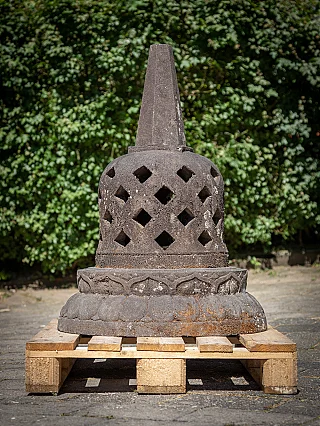
This is the classical age of Indonesian art. Under the Sailendra kings, Borobudur was built in Central Java, with 504 Buddha statues and more than 2,600 carved relief panels telling the life of the Buddha and the path to enlightenment. Close by stand the temple of Mendut, with a great seated Buddha teaching with both feet on the ground, and the Hindu temples of Prambanan. Read more about Borobudur.
East Javanese period (10th to 15th century)
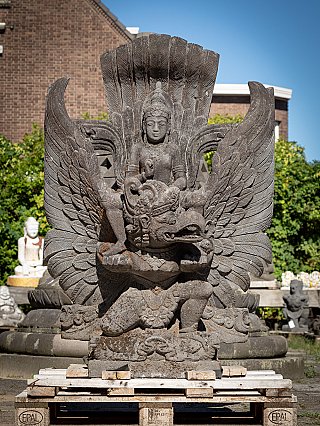
When power moved to East Java, the kingdoms of Kediri, Singhasari and Majapahit made sculpture that is more ornate and more formal, with rich jewellery and tall crowns. A famous example is the statue of Prajnaparamita, the goddess of perfect wisdom, from Singhasari. After the fall of Majapahit around 1500, Islam spread across Java and most temple building stopped.
Bali
On the island of Bali the Hindu tradition never ended. Balinese carvers work in soft volcanic tuff and in wood, making temple guardians, gods and decorative panels in a lively, richly detailed style that is quite different from the calm classical Javanese Buddha.
Lava stone carving today
Around Magelang and Muntilan, close to Borobudur, whole villages still live from carving lava stone. The carvers learn from the old temples and work almost entirely by hand, from large garden Buddhas to small heads and lanterns. Because the stone darkens and weathers quickly outdoors, a statue of a few decades can already look old, so always ask a dealer how old a piece really is.
Indonesian, Thai or Burmese? A quick check
A few simple things help you tell a Javanese Buddha from its neighbours:
- Material: dark volcanic stone points to Java. Thai and Burmese Buddhas are mostly bronze or gilded wood.
- Top of the head: a low, rounded ushnisha without a flame points to Java. A tall flame points to Thailand.
- Hands: the teaching and giving gestures are common in Java, while most Thai and Burmese Buddhas touch the earth.
Want to compare? Read about Buddha statues from Thailand and Buddha statues from Burma.
Buddhas, Bodhisattvas and Hindu gods
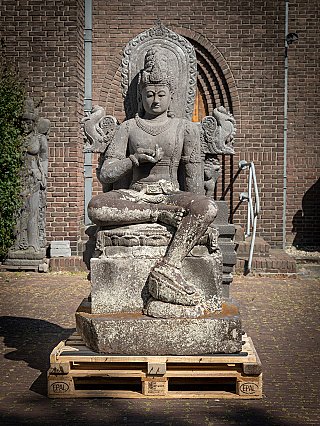
Next to the seated Buddha, Javanese workshops carve several other figures that collectors come across:
- Borobudur Buddhas. Seated Buddhas copied from the monument, each with one of its gestures. They are the most popular Indonesian statues for gardens and interiors.
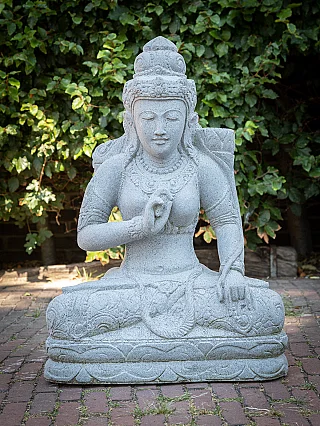
- Bodhisattvas and goddesses. Avalokiteshvara, the Bodhisattva of compassion, and the goddess Tara are shown crowned and jewelled, often standing against a back slab. Read about Avalokiteshvara and White Tara.
- Ganesha. The elephant-headed god of beginnings, very popular in Java and Bali. See our Ganesha statues.
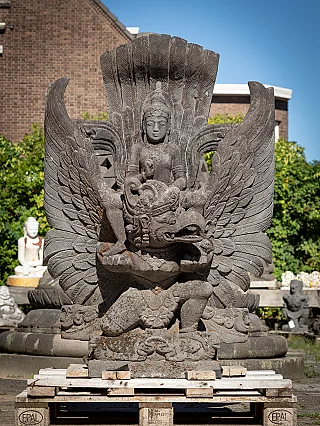
- Vishnu on Garuda. The god Vishnu riding the mythical bird Garuda, which is also the national emblem of Indonesia. See our Vishnu statues.
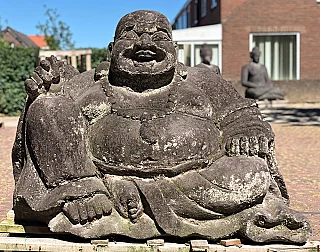
- Laughing Buddhas and lanterns. Javanese carvers also make the round, laughing Buddha of Chinese tradition and stone lanterns for the garden. More about laughing Buddha statues.
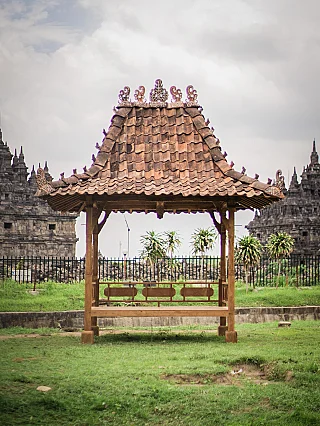
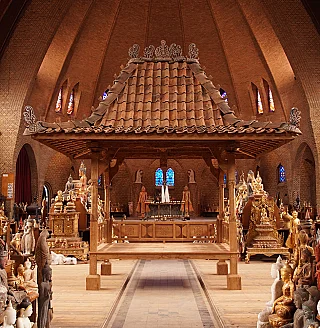
- Temple houses. Carved wooden shrines to place a statue in. See our temples and shrines.
Looking for ideas to place a statue outdoors? Read about creating a Buddha garden.
Materials: lava stone, bronze and wood
The material tells you a lot about where and when an Indonesian statue was made.
Lava stone
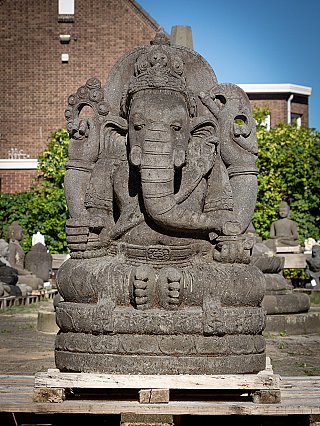
Lava stone, a hard volcanic rock, was used for Borobudur and Prambanan and is still the main material of Javanese carvers. It is heavy and strong, which makes it ideal for large statues and for the garden. A large lava stone Buddha can weigh several hundred kilos, so we deliver and place such pieces ourselves. Read more about lava stone Buddha statues and lava stones from Indonesia.
Bronze
Small bronze Buddhas and Bodhisattvas were cast in Central and East Java and in Srivijaya, often as private devotional images. Old Javanese bronzes are rare. Read about bronze Buddha statues.
Wood
Wood carving is strong on Bali and in Central Java, where teak and other hardwoods are used for figures, panels and shrines. Read about wooden Buddha statues.
Buddhism in Indonesia
Buddhism and Hinduism reached the islands along the trade routes from India in the first centuries AD and flourished for more than a thousand years. Today most Indonesians are Muslim and Buddhists are a small community, while Bali has kept its own Hindu religion. Borobudur is still a living place of pilgrimage: every year thousands of monks and pilgrims gather there to celebrate Vesak, the birth, enlightenment and passing of the Buddha.
Our buying trips in Indonesia
We have bought in Indonesia for many years. In 2013 we had wooden temple houses made to our own design by a small family workshop. In 2017 a buying trip to Java brought three full containers of lava stone Buddhas and garden lanterns to Deventer, and in 2023 we shipped five more containers of large hand-carved statues from Java. Read about the 2023 shipment, our 2017 trip to Java and our temple houses.
Where our Indonesian statues come from
We follow the laws of every country we buy in, and we guarantee that the age and information we give for every piece are correct. Read our authenticity guarantee and our article on how to identify an antique Buddha statue.
Frequently asked questions
How can I tell if a Buddha statue is from Indonesia?
Look at several features together: dark volcanic stone, a round and gentle face, small tight curls with a low ushnisha and no flame, a very thin robe and one of the Borobudur hand gestures. No single detail settles it on its own.
How old is my lava stone Buddha?
That is hard to see from the style, because Javanese carvers still copy the classical temples, and lava stone weathers quickly outdoors. Wear, tool marks and the way the stone has aged help, but moss and dark patches alone prove nothing. Ask the seller for the age and get it in writing. A good place to start is our article on how to identify an antique statue.
Can a lava stone statue stand in the garden?
Yes. Lava stone is hard and durable, and in Java it stands outdoors for centuries. Over time it will weather and may grow moss, which many people like. Ask us if you are unsure about your own garden or climate.
Why do Borobudur Buddhas have different hand gestures?
Each side of Borobudur faces a direction of the compass, and each direction has its own Buddha and gesture: touching the earth on the east, giving on the south, meditation on the west and reassurance on the north. Higher up, the Buddhas teach, and inside the stupas at the top they turn the wheel of the law.
Can I buy an old Indonesian statue legally?
Indonesia protects cultural objects that are fifty years old or more, and these may not be exported without permission from the government, so always ask a dealer where a piece comes from. We follow the laws of the countries we buy in. See our authenticity guarantee.
Do you deliver large lava stone statues?
Yes. We send statues from our gallery in Deventer, and delivery overseas is possible as well. Large and heavy pieces can be delivered and placed by us, also outside the Netherlands. See our order information.
Also from Indonesia: Hindu god statues, temples and shrines and laughing Buddhas.
Share this page