Krishna and Kaliya: The Dance on the Serpent
Author : Peter Vredeveld · Published
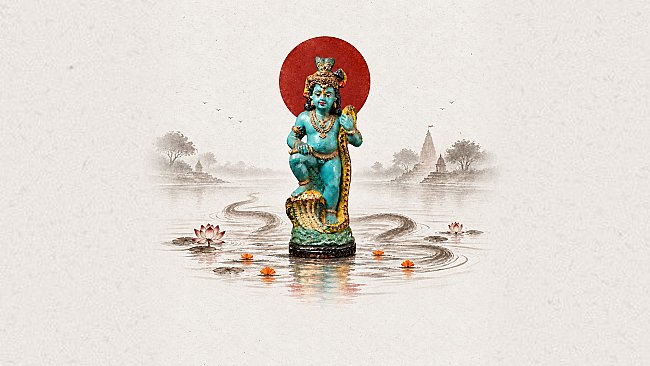
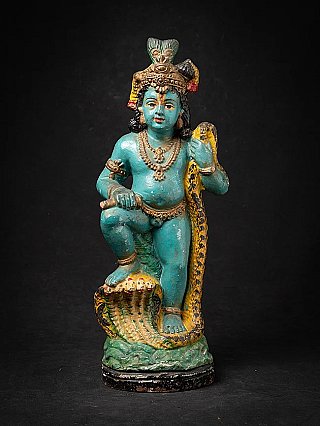
A small boy stands on the hoods of a giant serpent, one foot pressing down, the serpent's tail held firmly in his hand. He is not afraid. He looks almost playful. This is Krishna subduing Kaliya, one of the best loved stories in Hindu tradition, and a scene that artists in India have returned to for centuries.
In short: the story of Krishna and Kaliya comes from the Bhagavata Purana (Book 10, Chapter 16). The young Krishna dived into a poisoned pool of the Yamuna river near Vrindavan, broke free from the many-headed serpent Kaliya and danced on his hoods until he surrendered. Krishna spared his life, sent him back to his island home, and the river ran clean again.
Key facts
- Also known as: Kaliya Mardana, Kaliya Daman or Kaliya Nag Nathan, all meaning the subduing of Kaliya
- Main source: Bhagavata Purana, Book 10, Chapter 16, with versions in the Harivamsa and other Puranas
- Where: a deep pool in the Yamuna river at Vrindavan, in today's Uttar Pradesh
- Who: the child Krishna, the serpent king Kaliya and Kaliya's wives
- Outcome: Kaliya is spared and leaves the river, which becomes pure again
- Still celebrated: every year at the Nag Nathaiya festival at Tulsi Ghat in Varanasi
Who was Kaliya and why was he in the Yamuna?
Kaliya was a mighty naga, a serpent king with many heads. His true home was the island of Ramanaka. He fled from there to escape Garuda, the great eagle and mount of Vishnu, who hunts serpents. Kaliya chose a deep pool in the Yamuna near Vrindavan for one reason: because of an old curse placed on Garuda by the sage Saubhari, the eagle could not come there.
Kaliya was safe, but the river paid the price. His venom made the water boil and steam. Birds flying over it fell from the sky, cattle that drank from it died, and the grass along the banks withered. Only a single kadamba tree survived on the shore.
What happened when Krishna met Kaliya?
The dive. When the young Krishna saw his friends and their cows suffering, he climbed the kadamba tree and leapt into the poisoned water. In some tellings he was going after a ball that had fallen into the river. The cowherds on the bank watched in horror as the water closed over him.
The struggle. Kaliya rose up and wrapped Krishna in his coils, dragging him to the bottom. For a moment it looked as if the boy was lost. Then Krishna began to grow, swelling until the serpent had to let go.
The dance. Krishna sprang onto Kaliya's hoods and began to dance. Each step pressed down with the weight of the whole universe. One head after another sank as Kaliya grew weaker, until the serpent king could no longer rise.
Why did Krishna spare Kaliya?
This is where the story turns. Kaliya's wives, the serpent queens, came out of the water with their hands joined and begged Krishna to spare their husband. Kaliya himself, humbled at last, recognised who stood on his heads and asked for forgiveness.
Krishna stopped dancing. He did not kill Kaliya. He told him to leave the Yamuna and return to Ramanaka with his family, and promised that Garuda would never harm him again: the marks of Krishna's feet on his hoods would protect him. Kaliya left, and the river ran clean.
"To protect the good, to end what is evil and to restore dharma, I come into being from age to age."- Bhagavad Gita, 4.8
What does the story of Krishna and Kaliya mean?
The episode is read on several levels:
- Inner poison. Kaliya is often seen as the poison in each of us, such as pride, anger and fear, which slowly spoils everything around it
- Courage. A child faces the most feared creature in the land and does not run
- Compassion. Krishna subdues Kaliya but does not destroy him. Even the most dangerous figure in the story is given a way home
- A clean river. Today many people also read it as a story about restoring a polluted river, which gives it new meaning in India, where the Yamuna is under real pressure
How is Kaliya Mardana shown in Hindu art?
For sculptors and painters, the story offers one unforgettable image: a small child standing calmly on a raised serpent. You will find it in South Indian bronzes, in miniature paintings of the Bhagavata Purana, in temple carvings and in humble clay figures made for household shrines.
The scene is easy to recognise:
- Krishna balances on the serpent's spread hoods, usually five or seven, often with one leg raised in dance
- he holds Kaliya's tail in one hand, showing he is fully in control
- his other hand may be raised, or held in a gesture of protection
- the coils curl around the base, sometimes above stylised waves of the Yamuna
- in some versions the serpent queens kneel beside Kaliya with their hands joined
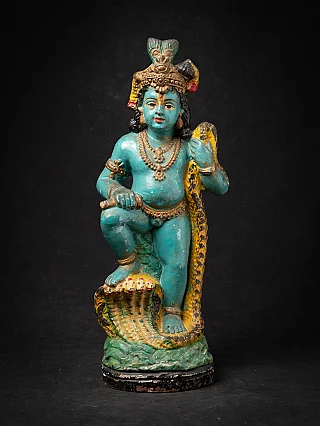
A lovely example in our collection is this antique painted terracotta Krishna from India. His skin is painted turquoise blue and he wears a tall crown with a peacock feather. One foot rests on the five hoods of a yellow and black serpent while he grips its long body. Green waves at the base hint at the river, and the worn, chipped paint shows a figure that has lived through generations of use.
Kaliya Mardana is only one of Krishna's forms in art. To recognise the others, from the flute player to the divine child, see our Krishna statues page, or read more about Krishna's life as an avatar of Vishnu.
Nag Nathaiya: the story still performed in Varanasi
The legend is not only kept alive in art. Every year in the Hindu month of Kartik, usually in November, crowds gather at Tulsi Ghat in Varanasi for Nag Nathaiya, a re-enactment of Krishna's victory over Kaliya that has been held there for centuries.
A large kadamba branch is set up at the edge of the Ganges. A boy playing Krishna jumps from it into the river, then rises again standing on the head of a giant serpent figure, holding a flute. Helpers in the water turn the serpent in a slow circle while thousands watch from the steps and from boats, and the Maharaja of Varanasi follows it from his royal boat.
Did you know? Nag Nathaiya is said to have been started at Tulsi Ghat in the 16th century, which makes this river performance more than 400 years old.
Frequently Asked Questions
- What is the story of Krishna and Kaliya? The young Krishna dived into a pool of the Yamuna poisoned by the serpent king Kaliya, overpowered him and danced on his hoods. When Kaliya and his wives asked for mercy, Krishna spared him and sent him away, and the river became pure again.
- What does Kaliya Mardana mean? Mardana is Sanskrit for crushing or subduing, so Kaliya Mardana means the subduing of Kaliya. Kaliya Daman means the same. Both names are used for the story and for statues of this scene.
- Where is the story of Kaliya told? The best known version is in the Bhagavata Purana, Book 10, Chapter 16. The story also appears in the Harivamsa and in several other Puranas.
- Did Krishna kill Kaliya? No. Krishna defeated Kaliya but spared his life after Kaliya's wives pleaded for him. He sent Kaliya back to the island of Ramanaka and promised him protection from Garuda.
- How many heads did Kaliya have? The texts describe him with many heads, and some tellings give him a hundred or more. In sculpture he is usually shown with five or seven hoods so the scene stays clear.
- When is Nag Nathaiya celebrated? Nag Nathaiya takes place at Tulsi Ghat in Varanasi on the fourth day of the bright half of the month of Kartik, which usually falls in November.
- Where can I find a Krishna Kaliya statue? Antique Kaliya Mardana figures appear in bronze, stone, wood and painted terracotta. You can see the pieces we have available on our Krishna statues page.
The next time you see a small blue figure dancing on a serpent, you will know the whole story behind it: a poisoned river, a fearless child and an ending built on mercy. For another of Krishna's best loved stories, read Krishna and Sudama: The Story of True Friendship.
Sources: Bhagavata Purana, Book 10, Chapter 16; Kaliya (Wikipedia); Nag Nathaiya (Wikipedia); Nag Nathaiya Leela, Incredible India
View our Krishna Statues Collection
Share this page